Your AI system just rejected a claim that should have been approved. The patient is waiting. Your billing team doesn’t know why the AI made that decision. And you have no audit trail to show them.
This scenario isn’t hypothetical. It’s happening in healthcare systems right now. And it’s expensive, not just in the immediate cost of rework, but in liability, compliance risk, and the slow erosion of trust in your AI system.
The silent killer isn’t the AI itself. It’s what happens when that AI operates without governance.
What Ungoverned AI Actually Costs
Most healthcare leaders think about AI governance as compliance theater—a checkbox for auditors. In reality, it’s the infrastructure that lets AI create value without destroying trust.
The costs of ungoverned AI fall into four categories:
- Operational drift: Your AI model was 92% accurate in the pilot. Six months after launch, it’s 79% accurate. You don’t know why. You have no monitoring in place. Meanwhile, it’s making decisions on 10,000 transactions a day. How much damage has it done?
- Liability exposure: An AI recommendation leads to a billing error that affects patient care. Your legal team asks: can you prove the AI was working as designed? Do you have audit logs? If you can’t answer yes, you’re looking at discovery problems and unexplained liability.
- Staff distrust: Your billing team doesn’t trust the AI because they can’t see why it makes decisions. So they override it 40% of the time. You’ve built a $2M system that people ignore. That’s not a technical problem—it’s a governance problem.
- Regulatory risk: Regulators are starting to care about AI governance. Your competitor gets audited and discovered they can’t explain their AI’s decisions. Your compliance team realizes you can’t either. Budget for a remediation project that costs 3-5x what proper governance would have cost upfront.
The Three Pillars of AI Governance
Proper AI governance doesn’t require a huge program. It requires three core elements working together.
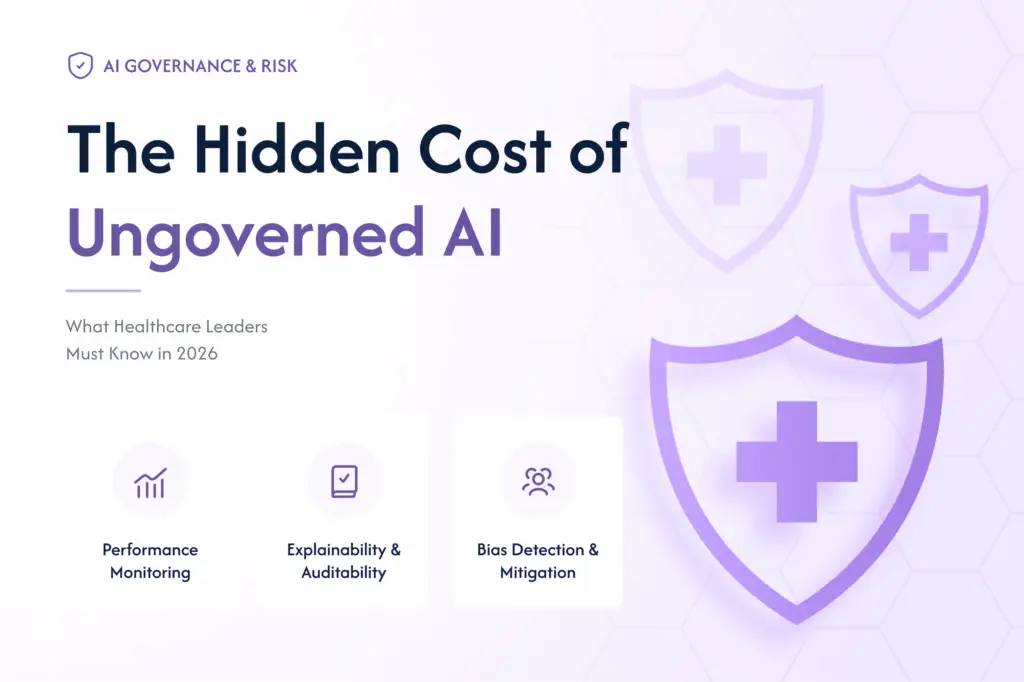
Pillar 1: Performance Monitoring
The moment your AI goes live, it starts to change. Not because the code changes, but because the real-world data it processes is different from training data. New patient populations. New diagnoses. New patterns. Your AI model degrades silently against this new reality.
Effective performance monitoring means:
- Baseline metrics: Before your AI goes live, define what success looks like. Accuracy? Sensitivity? Specificity? Precision? If you can’t measure it, you can’t manage it.
- Continuous measurement: Set up dashboards that track your AI’s performance in real time. Not monthly or quarterly—weekly at minimum.
- Escalation thresholds: Define what triggers action. If accuracy drops below 85%, who gets notified? What’s the procedure?
Pillar 2: Explainability & Auditability
“The AI decided” is not an acceptable explanation in healthcare. Your clinicians, your compliance team, and increasingly, your regulators want to know why.
Effective auditability means decision logs, feature importance tracking, and user-facing explanations. Every decision must be traceable and explainable.
Pillar 3: Bias Detection & Mitigation
Your AI learns from historical data. If that data contains biases—and in healthcare, it always does—your AI will perpetuate them. Then amplify them. Then systematize them.
Pre-deployment audits across demographic groups, post-deployment monitoring, and transparency when bias is discovered are essential.
Building a Governance Program
You don’t need a massive governance team. You need clarity on three things: Ownership, Process, and Tools.
The organizations that get AI right aren’t the ones with the most advanced models. They’re the ones that govern them.
About btcnxt.ai
btcnxt.ai builds governance frameworks that let healthcare AI scale safely. From performance monitoring to bias detection to decision auditability, we help you build the infrastructure that lets AI create value without risk.
At BTCNXT, we recognize that RCM companies don’t need another subscription login. You need a partner who understands the plumbing of US healthcare. BTC’s experience delivering healthcare software and AI‑driven solutions shows that success requires starting from the operational reality of billing teams, not from generic models or pre‑packaged tools. This means deeply understanding provider workflows, coding nuances, and compliance constraints before choosing algorithms or architecture.We specialize in,