An executive team gathers for the final go/no-go meeting before launching an AI-powered prior authorization system. The technical validation is complete. The vendor has presented strong accuracy numbers. The project has been in flight for eight months and everyone is eager to launch. Someone on the compliance team asks a question that stops the room: if this system denies a prior auth incorrectly and a patient’s care is delayed as a result, who is accountable, and what do we tell that patient’s family? Nobody in the room has a crisp answer. The meeting that was supposed to be a formality turns into a two-week delay while the organization builds an answer it should have had before the meeting started.
This scene repeats itself across healthcare organizations launching AI, and it happens for a specific, avoidable reason: technical validation and business readiness are treated as the same thing, when they are not. A model can be accurate, the business case can be sound, the vendor can be reputable, and the organization can still be unprepared to actually operate the AI safely once it touches real patients and real claims. The gap is not technical. It is organizational, and it shows up as unanswered questions that surface at the worst possible moment — usually right before launch, or worse, right after an incident.
This gap is remarkably consistent across organizations of very different sizes and sophistication levels. A five-hospital regional system and a large academic medical center both tend to arrive at the same finding: the technical team did their job well, the vendor did their job well, and the organization itself never quite closed the loop on accountability, escalation, and communication. This is not a knock on any individual involved. It happens because technical validation has clear, well-established methodologies that everyone recognizes as necessary, while organizational readiness has no equivalent standard checklist that project teams are trained to run through. The six questions below exist to fill that gap.
The way to close this gap is to force these questions to the surface early, in a structured readiness review, rather than letting them surprise the room during the go/no-go meeting. Six questions consistently separate organizations that launch AI safely from those that discover their gaps the hard way. None of these questions is exotic. All of them should be answerable in a single sentence, with a specific name attached, before any AI system touches a real patient or a real claim.
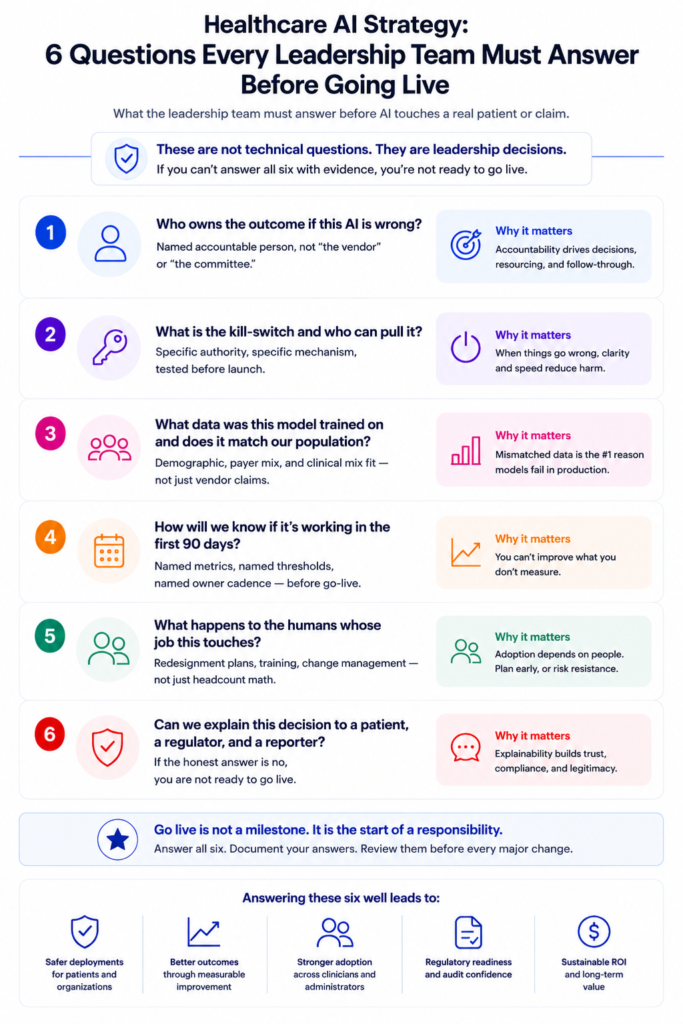
Question 1: Who Owns the Outcome If This AI Is Wrong?
This question sounds obvious and is answered badly more often than any other on this list. The wrong answers are common and revealing: ‘the vendor is responsible,’ ‘the AI steering committee owns it,’ ‘it’s a shared responsibility across IT and clinical operations.’ None of these is a real answer, because none of them names a specific person who can be called at 9pm when something goes wrong and who has the authority to make a decision without convening a committee first. The right answer is a named individual — a specific chief medical information officer, a specific VP of revenue cycle, a specific director — whose job includes owning the consequences of this particular AI system’s decisions. If your organization cannot name that person in one sentence, you do not yet have real accountability in place, regardless of how many governance documents describe the theoretical structure.
Question 2: What Is the Kill-Switch, and Who Can Pull It?
Every AI system deployed in a clinical or financial workflow needs a tested mechanism for taking it out of production immediately, and a named person with the authority to do so without needing sign-off from a committee that might not be able to convene quickly. This sounds like a technical requirement, but the failures here are almost always organizational rather than technical: the kill-switch exists on paper but has never actually been exercised, so nobody knows whether it works cleanly or creates a mess when triggered; or the authority to pull it sits with a committee rather than an individual, which means the system keeps running for hours or days while people try to coordinate a decision that should take minutes. Before go-live, the kill-switch should be tested in a dry run, and the person with authority to pull it should have actually done so once in a controlled setting, not just read a document describing the process.
Question 3: What Data Was This Model Trained On, and Does It Match Our Population?
A model validated on a large academic medical center’s patient population may perform very differently against a rural community hospital’s population, a pediatric population, or a population with a different payer mix. This is not a hypothetical concern; it is one of the most common causes of real-world AI underperformance in healthcare, and it is almost always discoverable before launch if anyone asks the question directly. The vendor’s validation statistics are a starting point, not a substitute for your own validation against your own population. Before go-live, the organization should have run the model against a representative sample of its own historical data and confirmed that performance holds up across the demographic, clinical, and payer-mix subgroups that matter for your specific patient population — not just accepted the vendor’s aggregate numbers at face value.
Question 4: How Will We Know If It's Working in the First 90 Days?
This question forces the organization to specify, before launch, exactly which metrics it will track, exactly what threshold constitutes success or concern, and exactly when the first formal review will happen. Organizations that skip this step tend to discover, three or four months after launch, that they never agreed in advance on what ‘working’ means — which means every stakeholder is now interpreting ambiguous early results through their own lens, and disagreements about whether to continue, pause, or adjust the deployment become political rather than evidence-based. The specific metrics should span accuracy, adoption, financial impact, and risk indicators, as covered in a complete AI performance measurement framework, and the specific 90-day review date should already be on a calendar before the system goes live, not scheduled reactively once someone notices a problem.
Question 5: What Happens to the Humans Whose Job This Touches?
Every AI deployment that touches a workflow touches the people who currently do that work, and the organizations that skip this question predictably encounter internal resistance, quiet sabotage, or simple non-adoption from the staff whose cooperation the AI depends on. The wrong answer here is a headcount reduction plan disguised as a workforce strategy. The right answer names specifically what these staff members will do differently — redeployment to higher-value work, a changed role definition, additional training — and communicates that plan to the affected staff before launch, not after they discover the change has already happened around them. Staff who understand what is happening to their role and see a credible path forward become allies in a successful deployment. Staff who are left to speculate become the reason a technically sound AI system fails to gain adoption.
Question 6: Can We Explain This Decision to a Patient, a Regulator, and a Reporter?
This is the question that tests whether the organization actually understands what the AI is doing, or is simply trusting a vendor’s black box. If a patient’s prior authorization is denied by this AI, can someone explain in plain language why, in terms the patient can understand and act on? If a state regulator asks how this AI makes decisions and what safeguards exist, does the organization have a clear, accurate, and complete answer, or does it have to go back to the vendor and hope for a good one? If a reporter is writing a story about AI in healthcare and asks how your organization uses it responsibly, is the honest answer something you would want printed? If the honest answer to any of these is no, or ‘we’re not sure,’ the organization is not ready to go live — not because the technology is unsafe, but because the organization does not yet have the operational and communicative readiness that responsible deployment requires. Getting to a confident yes on all three audiences is achievable, but it requires deliberately building explainability into the deployment rather than assuming it will be there when needed.
How to Actually Run This Review
The right time to ask these six questions is not the final go/no-go meeting, and treating them that way is exactly what produces the two-week delay in the story that opened this article. The right time is at project kickoff, before the vendor contract is signed, before the technical validation work even begins. Asking them early does two things. It surfaces the organizational gaps while there is still time to close them without derailing a launch date. And it forces the vendor selection process itself to account for these questions — a vendor who cannot support your kill-switch requirement, or who cannot produce validation data for a population like yours, should be a factor in vendor selection, not a surprise discovered after the contract is signed.
A useful practice is to revisit all six questions at three points in the project: at kickoff, when the answers are aspirational and mostly about planning; at the midpoint, typically around the technical validation phase, when the answers should be firming up into specifics; and at the final go/no-go review, when every answer should be concrete, tested, and signed off by a named owner. This rhythm turns the checklist from a single gate that creates last-minute friction into a running conversation that the project team owns throughout, which is both faster and more thorough than treating readiness as a single hurdle at the end.
It is worth being explicit about what this checklist is not. It is not a replacement for technical validation, clinical safety review, or IT security assessment — those processes still need to happen, and happen rigorously. The six questions are a complementary organizational readiness layer that technical processes routinely miss, because technical validation teams are optimized to answer ‘does the model work’ and are not always positioned to answer ‘is the organization ready to operate it responsibly.’ Both layers are necessary. Neither substitutes for the other.
Organizations that build both into their standard AI deployment process consistently launch with fewer surprises and recover faster on the rare occasions something does go wrong, because the accountability, escalation, and communication structures were built and tested before they were needed rather than improvised under pressure afterward. The investment required to answer these six questions properly is genuinely small compared to the project timelines most healthcare AI deployments already run on — a few workshops, a few named decisions, a kill-switch dry run. What it buys in return is the difference between a launch the organization controls with confidence and a launch the organization is quietly hoping goes well. For anything touching real patients or real revenue, that difference is worth insisting on before the go-live date is locked in, not after.
About BTCNXT
BTCNXT helps healthcare leadership teams build AI readiness reviews that surface accountability, risk, and workforce questions before launch — not after an incident forces the conversation.