A VP of revenue cycle brings a proposal to her executive team: automate the whole revenue cycle over the next 18 months. The board is enthusiastic, the CFO is supportive, the vendors have been eager, and the operational leaders are cautiously optimistic. Six months later, the picture is more complicated. Some of the automation is delivering exactly what was promised — eligibility verification is running clean, claim status checks have moved off the queue entirely, ERAs are posting automatically. Other pieces are struggling. The denial appeal automation has produced letters the payers are rejecting because they miss local nuance. The prior authorization automation has flagged so many exceptions that the human team is drowning in escalations. The charity care AI recommended two decisions that leadership had to reverse publicly. The lesson emerging from all of this is not that automation was a mistake. It is that automation was applied everywhere instead of somewhere, and the everywhere approach guaranteed some of it would fail.
Revenue cycle work is not homogeneous. Some parts of it are high-volume, rule-based, and reversible — perfect for full automation. Other parts are high-volume but judgment-dependent, where AI can assist a human but should not decide alone. Others are low-volume and rule-based, technically automatable but not worth the effort. And some are low-volume and judgment-heavy — the exact wrong place to apply automation because the volume does not justify the effort and the judgment complexity means errors are expensive. Treating all four categories the same is what produces the mixed results healthcare organizations keep experiencing.
The right way to plan RCM automation is with a priority matrix that sorts every use case along two axes: how much volume runs through it, and how clearly the decision rules can be specified. Every RCM function falls into one of four quadrants, and each quadrant has a different appropriate response. The order in which you tackle these quadrants determines whether your automation program compounds or fragments. This article walks through the matrix, the reasoning behind it, and the sequencing that consistently produces the results healthcare organizations want from RCM automation.
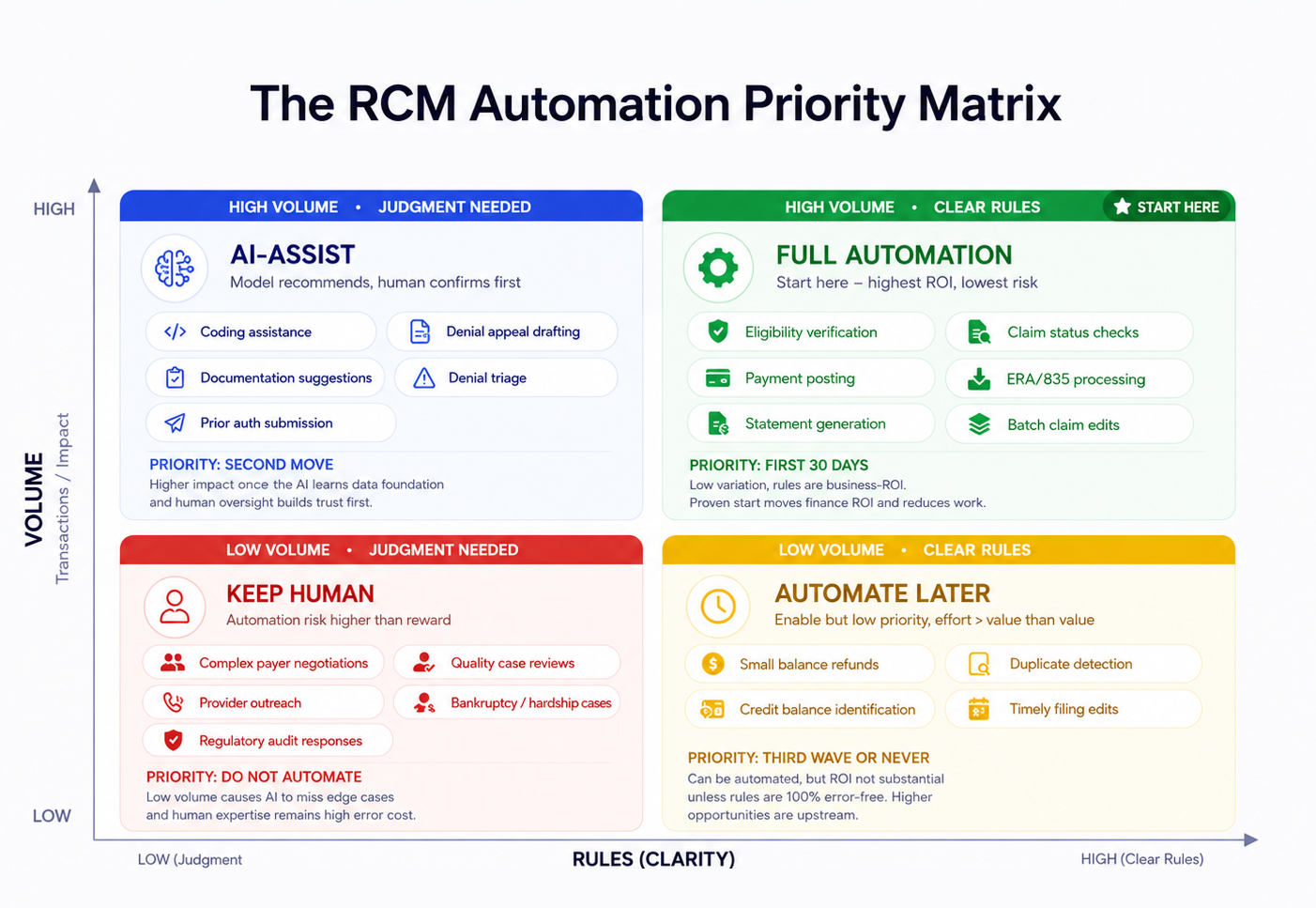
Quadrant 1: Full Automation — Start Here
The upper-right quadrant of the matrix — high volume, clear rules — is where full automation belongs, and where every RCM program should begin. The characteristics are specific: the transaction happens thousands of times per week, the decision rules can be fully specified, and if the automation is wrong, the error is either easily detected or easily reversed. Eligibility verification is the archetype. Every scheduled patient needs to be checked for coverage, network status, and prior authorization requirements. The rules are clear: does this insurance cover this service for this provider on this date? An AI system can run this check in seconds against every scheduled patient. If it’s wrong occasionally, the human team catches it during scheduling or check-in.
Claim status checks belong here for the same reason. So does payment posting when EOBs and ERAs arrive in structured form. So does statement generation, batch claim edits against clean payer-specific rules, and the initial pass on ERA and EOB processing. These functions share three properties that make full automation appropriate: they are high-volume enough to matter, they are rule-based enough to specify, and they are reversible enough that occasional errors are recoverable. Start here because the ROI arrives quickly, the risk is low, and the freed-up staff time can be redeployed to higher-value work. Organizations that skip this quadrant to chase more sophisticated use cases consistently regret it. The unglamorous automation is where the initial credibility of the entire program gets established.
Quadrant 2: AI-Assist — Second Wave, Highest Value
The upper-left quadrant — high volume, judgment-dependent — is where AI-assist belongs. These are the functions with the highest per-transaction value in the entire revenue cycle, which is exactly why they cannot be fully automated. Coding assistance sits here: high volume, requires professional judgment about which of several codes best represents the documented care, and errors cost money in both directions. AI can propose codes, flag ambiguity, and enforce coding rules, but the coder makes the final call. Denial appeal drafting sits here for the same reason. AI can generate an appeal letter with cited evidence in ten minutes; the specialist reviews, adjusts for the specific payer relationship, and submits. Documentation completeness works this way: AI reads the note, identifies gaps, and prompts the physician; the physician decides whether the gap needs filling.
The second-wave placement is not because these use cases are less valuable. They are more valuable, often dramatically so. It is because they require the data foundation, model governance, and human oversight infrastructure that come from doing Quadrant 1 first. Attempting AI-assist without those foundations produces exactly the failures that make executive teams lose confidence in AI. Attempting Quadrant 1 first builds the muscle needed for Quadrant 2 to succeed. Once you reach it, expect denial rates to drop 30-40%, coding accuracy to increase to 99%+, and appeal volume to double or triple without adding headcount. This is where the transformative RCM results come from — but only when you have earned the right to be there by getting Quadrant 1 right first.
Quadrant 3: Keep Human — Do Not Automate
The lower-left quadrant — low volume, judgment-dependent — is where automation delivers negative value if attempted. Complex payer negotiations belong here. Charity care decisions belong here. Ambiguous medical necessity determinations that require case-by-case reasoning belong here. Bankruptcy and hardship cases belong here. Regulatory audit responses belong here. Each of these functions shares two characteristics that make automation inappropriate: the volume is low enough that automation efficiency gains are minimal, and the judgment complexity is high enough that errors are expensive to recover from. A charity care decision made wrong is a reputational risk. A payer negotiation strategy applied wrong loses contract value that takes years to rebuild.
Organizations that try to automate this quadrant almost always do it because they got excited about AI and looked for more places to apply it. The results are consistent: high-visibility errors that undermine the credibility of the AI program as a whole. Every dollar and hour spent trying to automate this quadrant is subtracted from the returns of the quadrants where automation actually works. Discipline is required to say no to these use cases, because internal advocates keep proposing them, but the discipline pays off. Keep human judgment where human judgment is what the operation actually needs. Deploy the AI budget where it produces returns.
Quadrant 4: Automate Later — Third Wave or Never
The lower-right quadrant — low volume, clear rules — contains work that can be automated but probably shouldn’t be automated first. Small balance refund processing sits here. Duplicate detection across accounts sits here. Credit balance identification sits here. Timely filing edit checks sit here. Each of these is technically straightforward to automate. The rules are clear, the risk is low, the outcomes are easily verified. But the total addressable value is small. Automating a process that runs 50 times a month saves an hour or two of labor, which is meaningful but not transformative. Doing it before you’ve fully automated the higher-volume Quadrant 1 or captured the higher-value Quadrant 2 is a misallocation of engineering time.
The appropriate handling for this quadrant is patience. Once your Quadrant 1 and Quadrant 2 work is stable and mature, if you have engineering capacity to spare, come back and automate these lower-value functions. If you don’t have capacity to spare, leave them alone. The opportunity cost of automating them is real: every engineering hour spent here is an engineering hour not spent on the next high-value use case. Some healthcare organizations never get to Quadrant 4, and that is fine. It means their AI program stayed focused on the work that mattered most.
Common Miscategorizations
The matrix looks simple, but the categorization decisions inside it are where organizations most often go wrong. Three miscategorizations show up repeatedly and account for most of the automation programs that stall or backfire. The first is treating prior authorization as Quadrant 1 rather than Quadrant 2. Prior auth submission looks rule-based on the surface — a set of forms with defined fields — but the actual decision of whether to submit, when to submit, and what supporting documentation to attach depends on payer-specific patterns that shift monthly and clinical context that requires interpretation. Organizations that try to fully automate prior auth end up with either a mountain of exceptions or a stream of denials that trace back to nuances the AI missed. AI-assist is the right placement: the AI drafts the submission, the human reviews and adjusts before it goes out.
The second common miscategorization is treating denial resolution as if all denials belong in the same quadrant. They don’t. Administrative denials with structured reason codes and standard rebuttals belong in Quadrant 1 — pure automation can resubmit or generate a standard appeal without human involvement. Clinical medical-necessity denials belong in Quadrant 2 — the AI drafts the appeal with cited evidence, but a specialist reviews before submission. Some denials belong in Quadrant 3 entirely: the payer relationship is complex enough that appeal strategy is a case-by-case decision. Bundling all denial work into one quadrant produces either overly cautious automation that leaves easy wins on the table, or overly aggressive automation that damages payer relationships. Split the work by type.
The third miscategorization is treating patient collections as Quadrant 1. Sending payment reminders and posting straightforward payments is Quadrant 1. Actually deciding when and how to escalate a delinquent balance — offering a payment plan, sending to collections, writing off — requires judgment about the patient’s situation, prior communication history, and organizational policy about compassionate collection. Automating the escalation decision without human judgment produces exactly the kind of collections practices that generate patient complaints and reputational damage. The transactional pieces automate; the escalation decisions stay human. Getting these categorizations right matters more than the raw automation capability. Two organizations can buy the same AI tools and get opposite results based on how they placed each use case on the matrix.
The Sequencing Rule
The sequencing rule that emerges from the matrix is simple: Quadrant 1 first for the first 90 days, Quadrant 2 next for the following 6-12 months, Quadrant 4 only if capacity permits, and Quadrant 3 never. Organizations that follow this rule consistently report the compounding returns they expected from RCM automation. Organizations that skip around — chasing exciting Quadrant 2 use cases before building Quadrant 1 foundations, or getting distracted by Quadrant 3 opportunities because internal advocates keep proposing them — usually report the mixed results that make executive teams question the entire premise. The rule is not glamorous. It says the first 90 days of your program should be about the most boring, most well-understood, lowest-risk automation opportunities. But that is exactly what turns automation from an aspiration into an operating capability. Once eligibility verification, claim status, payment posting, and statement generation are running clean, the organization has the data infrastructure, the operational discipline, and the executive confidence needed to take on the harder Quadrant 2 work with a real chance of success. The disciplined path may look slower on paper, but it consistently reaches the finish line while the everywhere-at-once approach stalls somewhere in the middle of the map.
About BTCNXT
BTCNXT builds RCM automation programs sequenced by the priority matrix — starting with high-volume, high-clarity automation and progressing to AI-assisted judgment work as foundations mature. We help revenue cycle leaders turn automation from a wishlist into a working operating model.