It’s 9 AM on Monday. A patient calls your hospital billing department asking about their balance. A billing clerk searches through five different systems trying to locate their account. Patient transferred from urgent care on Friday—information might be in the legacy system or new system. The search takes 10 minutes while other patients’ calls back up. Meanwhile, another staff member manually scans insurance forms into your system one by one. A third manually enters data from referral letters into your scheduling system by reading the letter and typing information. A fourth spends an hour correcting errors in auto-populated forms because the Intelligent Document Processing got 95% of the fields right but the 5% that’s wrong broke downstream processing—wrong specialty code, wrong location, wrong insurance company name. These corrections require human investigation and rework. A person spends hours fixing issues that shouldn’t exist if the initial data extraction had been perfect.
This is the document processing reality of healthcare. Every organization of significant size processes thousands—often tens of thousands—of documents daily. Insurance forms when patients present. Clinical documents: referral letters, prior authorization requests, operative reports, discharge summaries. Financial documents: invoices, statements, payment records. Authorization documentation. Consent forms. Each document needs scanning, organizing, data extraction, and information entry into downstream systems. The volume is staggering. The work is repetitive. The error rate is consistently 2-5% despite careful staff because humans make mistakes on repetitive data entry. The cost is brutal—paying staff $20-30/hour to do work that could be done by AI for $2-3 per transaction. You have staff whose primary responsibility is processing documents. They’re not providing patient care, not solving strategic problems, not improving operations. They’re entering data.
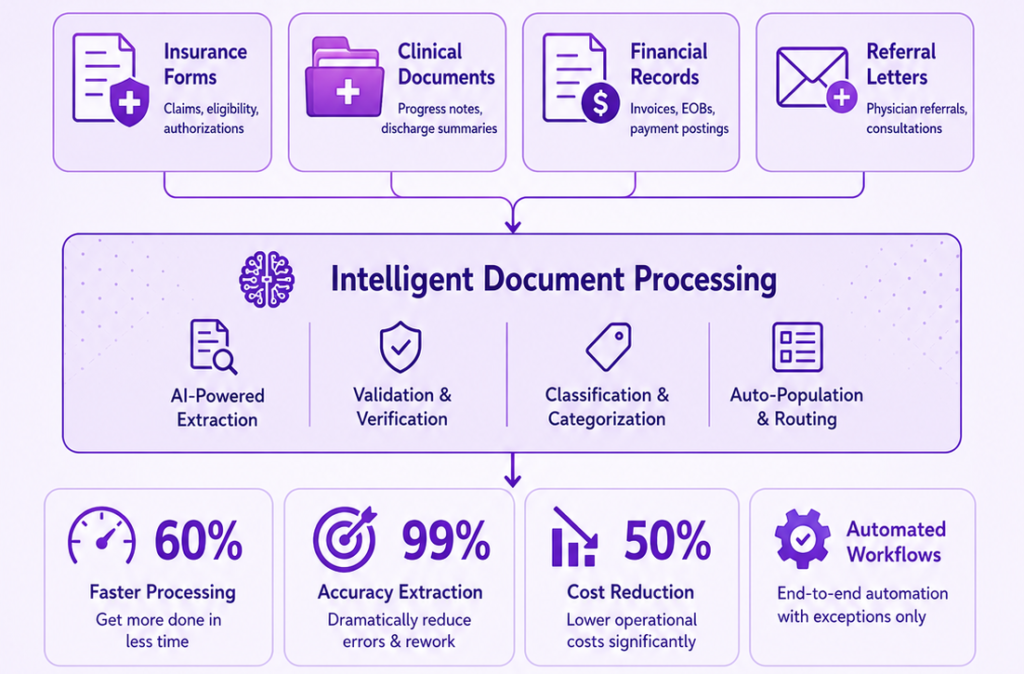
Intelligent document processing—automated extraction, classification, validation, and processing of documents using AI—solves this systematically. Not overnight, but workflow by workflow, healthcare organizations are discovering that they can automate 60-80% of document processing work with 99%+ accuracy and cut costs in half. They’re eliminating queues. Reducing staff stress. Improving data quality. Freeing people to work on things requiring human judgment rather than data entry.
This article walks through what IDP is, where it delivers immediate value, and how pragmatic organizations are implementing it to transform operations.
The True Cost of Manual Document Processing
Most healthcare organizations don’t accurately quantify the cost of document processing because it’s distributed across many departments and budget lines. Nobody aggregates it. But the real cost is substantial. Start with direct labor: A front desk clerk spends an hour per day handling intake forms. A registration staff member spends time scanning and organizing documents. A scheduler enters referral information manually. Insurance verification staff review and extract information. Clinical staff review documents for completeness. Billing staff organize and file documents. Compliance staff maintain documentation records. Finance staff process financial documents. A records/filing department maintains organization. Across a health system, you’re looking at 20-40 FTE dedicated primarily to document processing. At $50K per FTE fully loaded, that’s $1-2M annually in direct labor. But this massively understates total cost because that labor diverts from higher-value work. A registration clerk could improve patient experience instead of entering data. A scheduler could manage appointment slots instead of manually processing referrals. Clinical staff could prepare for patient care instead of hunting documents.
Error costs compound this dramatically. When documents process manually, errors are inevitable—not from carelessness but because humans make mistakes on repetitive tasks. A registration clerk misreads a date of birth. A scheduler misinterprets a specialty code. A staff member enters a number incorrectly. An insurance verification gets wrong information. These errors cascade: wrong appointment times require patient calls and rescheduling, denied claims require appeals (3-6 month resolution), payment posting failures require manual correction and investigation. The rework on a single error—especially in billing—consumes 5-10 hours across multiple people. One data entry mistake causing a claim denial and appeals might cost your organization $200-500 in staff time and lost revenue per occurrence. At a hospital processing 10,000 monthly documents with 2-3% error rate, that’s 200-300 errors monthly and $40K-150K in monthly rework costs.
Compliance and security risks add another layer. Documents get misfiled or lost. Information ends up in wrong places. Audit trails are incomplete. In healthcare, this creates regulatory and liability risk on top of operational cost. HIPAA compliance issues from mishandled documents can result in substantial penalties. If you can’t produce documents when audited, you’re exposed. The compliance cost compounds over time.
Three High-Value Use Cases
Use Case 1: Insurance Verification
Patients bring insurance cards or send insurance documents. Staff manually enter information. Errors are common: wrong subscriber, wrong group number, misread expiration date. These cause downstream claim denials that require appeals. IDP reads cards/documents, extracts information instantly with 99%+ accuracy, auto-populates systems. No errors. No rework. Processing time: manually 5 minutes per patient; IDP 30 seconds. A registration desk handling 8 verifications per hour per staff member can now handle 120 per hour per AI system. A hospital with 50,000 annual admissions where 30% require manual verification = 15,000 annual entries. Manual: 1,250 hours annually. IDP: 125 hours—90% reduction. Labor savings: ~$50K annually plus $20.8M in improved working capital from fewer denials.
Patient experience improves too. No more waiting. No more follow-up calls requesting missing information. Eligibility verified in seconds.
Use Case 2: Clinical Document Processing
Referral letters request appointments. Schedulers need to extract: patient name, DOB, reason, specialty, preferred dates, clinical priorities. Manually: 10 minutes per referral. IDP extracts automatically knowing which fields matter for scheduling. Validates completeness. Alerts staff if information missing. Processing time: 10 minutes to 1 minute for routine cases. Errors to near-zero. A large clinic receiving 5,000 annual referrals reduces processing time by 45,000 minutes (75 hours). At $30/hour loaded cost, that’s $2,250 direct savings. Real operational value: faster appointment availability—referrals turning into appointments in hours not days. Shorter wait times improve patient satisfaction and clinical outcomes.
Quality perspective: errors drop dramatically. No transcription errors causing wrong appointment times. No lost referrals. Complete audit trail means perfect traceability.
Use Case 3: Authorization & Compliance
Hospitals maintain authorization records, handle prior authorization requests, maintain compliance documentation. IDP classifies incoming documents, extracts critical information, stores securely with proper encryption, maintains complete audit trail. Need to prove a procedure was pre-authorized? Pull it up instantly with timestamp and documentation. Compliance becomes demonstrable. Risk drops because audit trail is transparent. Cost savings: staff maintain this at scale without additional FTE. Compliance teams handling authorization documentation with IDP: smaller team, better outcomes.
Getting Started: Phased Implementation
Smart healthcare organizations don’t automate everything at once. Pick one high-volume workflow with clear value and standardized documents. Insurance verification is ideal because cards follow standard format, value is immediate (eliminate denials), and success is measurable. Implement IDP for this workflow. Measure meticulously: labor time, error rates, denial rate impact, cost per transaction, staff feedback, validation accuracy. Document what works. Optimize based on real-world performance.
Once proven, expand to next workflow. Each rollout is faster and cheaper because you’ve learned patterns. Within 12-18 months, you’ve automated 4-5 major workflows. Within 24 months, you’ve covered nearly your entire document processing operation. Most organizations see ROI within 4-6 months from first implementation driven purely by labor savings. Compliance and error reduction benefits continue accruing and compounding.
About btcnxt.ai
btcnxt.ai helps healthcare organizations assess AI readiness across all five dimensions. From data cataloging to governance frameworks, we help you identify gaps and build a roadmap to readiness.
At BTCNXT, we recognize that RCM companies don’t need another subscription login. You need a partner who understands the plumbing of US healthcare. BTC’s experience delivering healthcare software and AI‑driven solutions shows that success requires starting from the operational reality of billing teams, not from generic models or pre‑packaged tools. This means deeply understanding provider workflows, coding nuances, and compliance constraints before choosing algorithms or architecture.We specialize in,