Your CFO reports that revenue is up 3% year-over-year. Your billing manager says operations are running smoothly. Yet somewhere between the clinical encounter and the money in your bank account, cash is systematically leaking out. Slowly. Invisibly. But definitely.
Healthcare systems bleed 2-5% of potential revenue through RCM workflow inefficiencies. For a $500M health system, that’s $10-25M annually. Most don’t know where the losses are happening because the leaks are distributed across dozens of small failures, not a single catastrophic break.
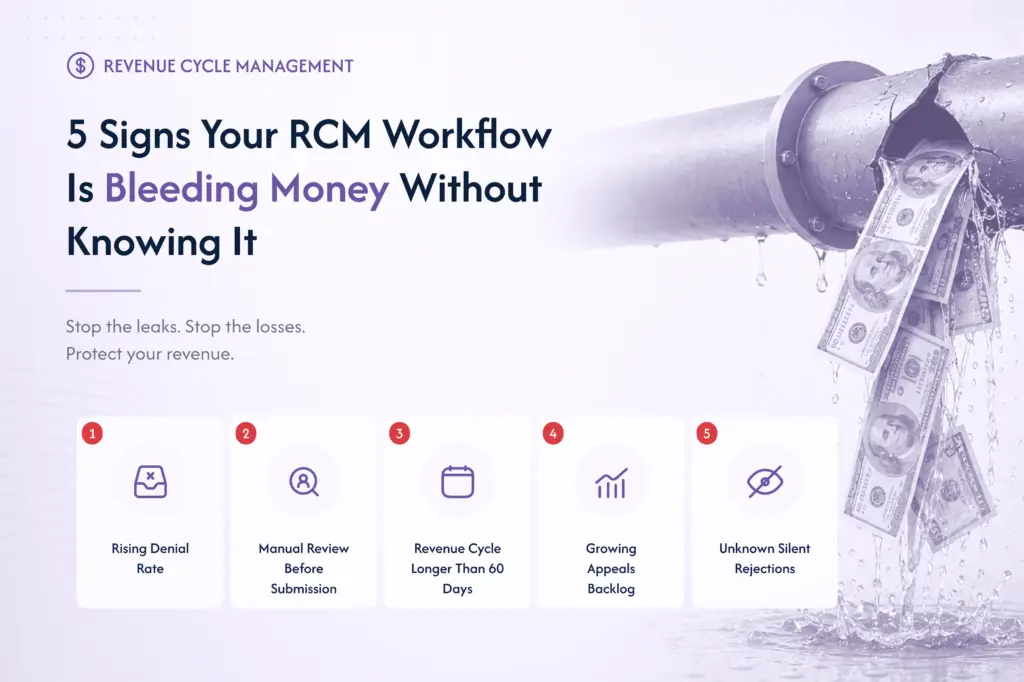
This article walks through the five diagnostic signs that your RCM workflow is costing you millions. More importantly, it explains why these failures happen and what modern approaches (including AI) can do about them.
By the end, you’ll understand not just where the money goes, but what to do about it.
The Anatomy of Revenue Leakage
Before we diagnose the five signs, let’s understand how revenue actually leaks from RCM workflows.
A claim’s journey from patient encounter to payment involves dozens of handoffs: clinical documentation capture, coding, compliance checking, charge entry, claim submission, payer follow-up, appeal management, and posting. At each handoff, there’s an opportunity for delay, error, or loss.
A claim rejected at payer due to missing documentation sits in accounts receivable for months. A denial that should have been appealed but wasn’t gets written off. A claim that fails your internal validation check but the human never catches the error is never resubmitted. A patient balance that could be collected gets aged out and becomes uncollectible.
These aren’t failures of individual people—they’re failures of workflows and systems. They happen because the process relies on manual oversight in an environment where volume is too high for perfect execution. The leaks are baked in.
Sign 1: Your Claim Denial Rate Is Rising
This is the clearest warning signal. Industry benchmark is 3-5% denial rate. If you’re above 5%, and especially if the rate is rising year-over-year, something in your workflow is broken.
Most denial rate increases come from one of four sources: (1) Changes in payer policies that your team isn’t aware of, (2) Increasing complexity of documentation requirements that your coders aren’t meeting, (3) Deteriorating clinical documentation quality from clinician burnout, or (4) Claims being submitted with incomplete information because your validation system isn’t catching errors before submission.
The financial impact: A 7% denial rate on $100M annual claims = $7M in denied revenue. Even if you ultimately recover 80% through appeals, you’ve lost months of cash flow. For every 1% increase in denial rate above benchmark, you’re looking at $1-2M in permanent revenue loss (claims that don’t get appealed or recover fully).
Diagnosis: Your denial rate is rising because your system can’t detect problems before submission or because claim quality has deteriorated.
Sign 2: A Significant Percentage of Claims Require Manual Review Before Submission
If 20% of your claims need human eyes before they can be submitted—because documentation is unclear, coding looks questionable, or compliance checks flag something—your process is critically inefficient.
Each claim that requires manual review introduces delay (1-3 days per claim) and error risk (humans miss things under time pressure). When you multiply this across thousands of claims, you’re looking at millions of dollars in delayed revenue.
Example: A health system with 10,000 claims per month where 20% require review = 2,000 claims. At 15 minutes per review, that’s 500 FTE hours per month, or $37,500 in labor (at $75/hour fully loaded). Annually, that’s $450,000 in pure review cost. Meanwhile, each day of delay compounds into cash flow impact and working capital cost.
Diagnosis: Your documentation quality or coding quality is inconsistent. Your validation system isn’t automating routine checks. You don’t have clear escalation rules for what requires human review vs. what can be auto-submitted.
Sign 3: Your Days in Accounts Receivable (DAR) Is Longer Than 60 Days
Industry benchmark for healthcare DAR is 40-50 days. If you’re consistently above 60 days, you have a structural problem in your revenue cycle.
DAR directly reflects how fast claims move from submission to payment. If it’s high, it means claims are sitting in queue at some stage: pending documentation review, waiting for payer response, or in appeals. Each day claims sit is a day the money isn’t in your bank account.
The working capital cost is substantial. A $500M health system with 60-day DAR has $82M in AR (2 months of revenue). If industry best practice is 45 days, you have $13.7M in excess AR—working capital that could be used for operations but is stuck in receivables. At a 5% cost of capital, that’s $685,000 per year in opportunity cost, not counting the operational cost of managing the aging receivables.
Sign 4: Your Appeals Backlog Is Growing
Appeals take months to resolve. A growing appeals backlog means denials are being generated faster than you can resolve them—a sign of systemic issues upstream.
Most health systems can handle appeals at a certain volume with their current staffing. If the backlog is growing, it’s because either: (1) Denial volume is increasing (sign that claim quality is deteriorating), or (2) Appeals resolution is taking longer (sign that your process is inefficient or payers are responding more slowly).
The cost compounds over time. An appeal that takes 6 months instead of 3 months means 3 additional months of cash flow delay on that claim. Some claims, especially old ones, never get appealed because they fall through the cracks—and those become permanent write-offs.
Sign 5: You Don't Know How Many Claims Are Being Silently Rejected
This is the most dangerous sign because you don’t know it’s happening. Some claims fail internal validation checks and never make it to the payer. They sit in a rejected state and your team doesn’t know they exist.
If you can’t answer “How many claims failed internal validation last month?” with a specific number, you have invisible leaks. These rejected claims represent lost revenue that nobody is actively pursuing because they don’t know the claims exist.
Some of these claims will eventually get fixed (when someone notices). Others will age out and never get fixed. You’ll never know the total amount of revenue that was lost.
Diagnosis: Your system doesn’t have visibility into all claims and their statuses. You lack monitoring and alerting for claims that get stuck.
How Modern AI Plugs These Leaks
The right AI system can address most of these problems simultaneously:
- Denial prevention: AI can identify high-risk claims before submission and route them for human review or auto-correct fixable issues.
- Documentation quality checks: AI can assess whether clinical documentation meets payer requirements and flag gaps before coding begins.
- Claims monitoring: AI can continuously monitor all claims in your system, flag any that get stuck, and alert staff to aging or high-risk items.
- Appeals optimization: AI can prioritize appeals based on recovery probability and time horizon, helping your team focus on high-value claims.
The organizations that stop bleeding money are the ones that address these five signs systematically. They don’t try to fix everything at once. They start with the biggest leak, measure the impact, then move to the next one.
About btcnxt.ai
btcnxt.ai helps healthcare organizations assess AI readiness across all five dimensions. From data cataloging to governance frameworks, we help you identify gaps and build a roadmap to readiness.
At BTCNXT, we recognize that RCM companies don’t need another subscription login. You need a partner who understands the plumbing of US healthcare. BTC’s experience delivering healthcare software and AI‑driven solutions shows that success requires starting from the operational reality of billing teams, not from generic models or pre‑packaged tools. This means deeply understanding provider workflows, coding nuances, and compliance constraints before choosing algorithms or architecture.We specialize in,