You started with one location. Revenue was predictable. Workflows were consistent. Everyone knew how things worked. The CEO could walk the hallways and understand what was happening.
Then you acquired a second facility. Fine. You integrated their systems, aligned the workflows, and things settled down. Then a third location. A fourth. Now you’re managing 15 facilities across three states, each with different patient populations, different provider preferences, different operational challenges.
Suddenly, consistency shattered. Each location runs their EHR differently. One uses a different billing vendor. Workflow variations emerged that nobody documented. When you try to report on system-wide metrics, the numbers don’t reconcile. When you try to standardize a process, you find out different locations do it fundamentally differently.
This is the fragmentation problem. And the bigger you get, the more expensive it becomes.
The Three Stages of Multi-Location Healthcare Operations
Understanding where you are on this journey is essential because it determines what problems you’re facing and what solutions will work.
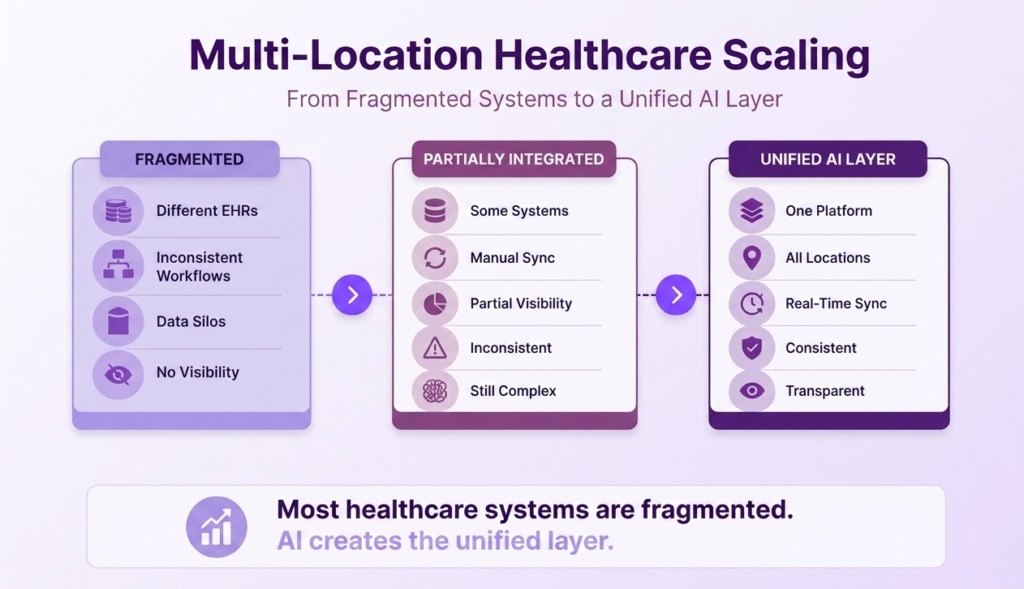
Stage 1: Fragmented (Most MSOs Start Here)
Each location has its own EHR or its own unique customization of the same EHR. The systems were chosen at different times by different teams to solve different problems. Different billing vendors. Different revenue cycle workflows. Different quality metrics. Different staffing structures.
The result: zero system-wide visibility. Your CFO can’t answer simple questions without days of manual work. ‘What’s our average revenue cycle length across all locations?’ Nobody knows without pulling data from 15 different systems and manually aggregating it. ‘Which location has the highest readmission rate?’ It takes weeks of gathering reports and spreadsheets.
Operational leadership becomes nearly impossible. You can’t implement a system-wide quality improvement program because you can’t measure quality consistently across locations. You can’t identify best practices from high-performing locations and spread them to underperforming ones because the practices are embedded in workflows that are context-specific and undocumented.
Cost: Fragmentation is expensive. You maintain duplicate infrastructure. You have redundant staff. You pay premium rates for contract labor because locations can’t share resources. You miss economies of scale in procurement because each location buys independently.
Stage 2: Partially Integrated (Where Most Aspire to Be)
You’ve invested in integrations. Data flows between locations. You have reporting dashboards that pull from multiple sources. Some workflows have been standardized. But it’s brittle and piecemeal.
Integration points are numerous but fragile. When a system goes down or a vendor changes their API, integrations break and nobody knows for days. Reports are built in Excel with manual data pulls. Syncs happen daily or weekly instead of in real-time. Inconsistencies persist because the underlying systems still aren’t truly aligned.
You gain some visibility, but decision-making is still slow and based on stale data. You can identify problems, but fixing them requires coordinating across locations with different systems and workflows. Best practices still don’t spread easily because they’re embedded in inconsistent processes.
Cost: You’ve spent millions on integration projects and you’re still not getting the benefits of true consolidation. Staff are frustrated because they’re working around system limitations constantly. You’re paying for integration maintenance and support indefinitely.
Stage 3: Unified with AI Layer (The Future, Achievable Today)
A single intelligent platform sits above all your disparate systems. It ingests data from every location’s EHR, billing system, lab information system, and operational tools in real-time. It normalizes that data into a unified schema. It understands context and can map inconsistent fields from different systems to standard definitions.
Now your CFO can ask “What’s our revenue cycle performance across all 15 locations?” and get an answer in seconds, not weeks. Your COO can see which locations have staffing challenges and which are running optimally. Your quality team can identify which providers are hitting standards and which need support. Most importantly: you can implement system-wide improvements because you have consistent data and can measure progress across all locations simultaneously.
You don’t need to rip-and-replace your systems. The unified AI layer sits on top of them, creating transparency and enabling coordination without forcing integration projects on unwilling locations.
Cost: You gain economies of scale, reduce redundancy, make better decisions faster, and can actually implement system-wide improvements. ROI appears within 18-24 months and compounds from there.
Why Fragmentation Gets Exponentially More Expensive as You Scale
The cost of fragmentation doesn’t scale linearly. It scales exponentially. Here’s why:
- Management overhead grows: Each new location adds new workflows to understand, new metrics to track, new coordination challenges. A single manager might be able to oversee 3-4 locations. Beyond that, you need regional directors. With each layer of management, decision-making gets slower and less informed.
- Data inconsistency spreads: As you add locations, data inconsistencies compound. Location A defines ‘readmission’ differently than Location B. Location C’s coding standards are different. System-wide reporting becomes not just slow but unreliable. You can’t trust the numbers because you’re not sure what they mean.
- Best practice dissemination fails: One location finds a way to reduce claim denial rates by 2%. Another optimizes their ED workflow. But spreading these improvements to other locations is nearly impossible because each location’s systems are different. The knowledge stays siloed.
- Acquisition friction increases: Each new acquisition is a separate integration project. You can’t leverage what you learned from the last acquisition. You don’t have playbooks. Instead of 6 months to integration productivity, it becomes 12-18 months. Your acquisition ROI suffers.
- Staff burnout accelerates: Your best staff get pulled into integration projects and system workarounds. They spend time reconciling data and managing inconsistencies instead of improving care or reducing costs. Turnover increases, especially among your top performers.
Moving from Fragmented to Unified: The Path Forward
The solution isn’t to force all locations onto a single EHR or system. That’s expensive, disruptive, and often fails. Instead, you create an intelligent layer that sits above your existing systems, understands their inconsistencies, and creates unified visibility and coordination.
This layer uses AI to normalize data from different systems. It learns which fields from which systems represent the same concept, even when they have different names or definitions. It fills in gaps with inference where data is missing. It creates unified reporting on top of fragmented sources.
The implementation path is pragmatic. Start with one or two critical use cases. Maybe it’s system-wide revenue cycle reporting. Maybe it’s readmission tracking across locations. Pick something that gives you clear ROI and that’s hard or impossible to do today. Build the capability for that use case. Prove the value. Then expand to other locations and other use cases.
You don’t need to boil the ocean. You need to demonstrate value, build momentum, and scale incrementally. Most organizations see payback on this type of investment within 12-18 months.
The Competitive Advantage: Organizations That Get This Right Win
MSOs that move to unified operations with AI intelligence gain substantial advantages over competitors who remain fragmented:
- Faster decision-making: Your executive team can see real-time data across all locations and make decisions based on facts, not gut feel.
- Acquisition leverage: You can confidently acquire new locations knowing you have a proven playbook for rapid integration and value creation.
- Cost efficiency: You optimize across the entire system, not individual locations. Procurement leverage, staffing efficiency, revenue cycle optimization all improve.
- Quality and outcomes: You identify best practices and spread them system-wide. Your quality outcomes improve faster than competitors who can’t share learning.
About btcnxt.ai
btcnxt.ai helps healthcare organizations assess AI readiness across all five dimensions. From data cataloging to governance frameworks, we help you identify gaps and build a roadmap to readiness.
At BTCNXT, we recognize that RCM companies don’t need another subscription login. You need a partner who understands the plumbing of US healthcare. BTC’s experience delivering healthcare software and AI‑driven solutions shows that success requires starting from the operational reality of billing teams, not from generic models or pre‑packaged tools. This means deeply understanding provider workflows, coding nuances, and compliance constraints before choosing algorithms or architecture.We specialize in,