You’re in a board meeting. Someone asks: “Are we AI-ready?”
Everyone nods. Someone says, “We’re working on it.” But what does that actually mean? What makes an organization “AI-ready”?
The term gets thrown around so much it’s almost meaningless. But it shouldn’t be. AI readiness is measurable. It’s specific. And it determines whether your AI initiatives succeed or fail.
AI Readiness Is Not a Single Metric
There’s no “AI Readiness Score” that applies to all organizations. But there are five specific dimensions that matter. Think of them as a framework, not a test.
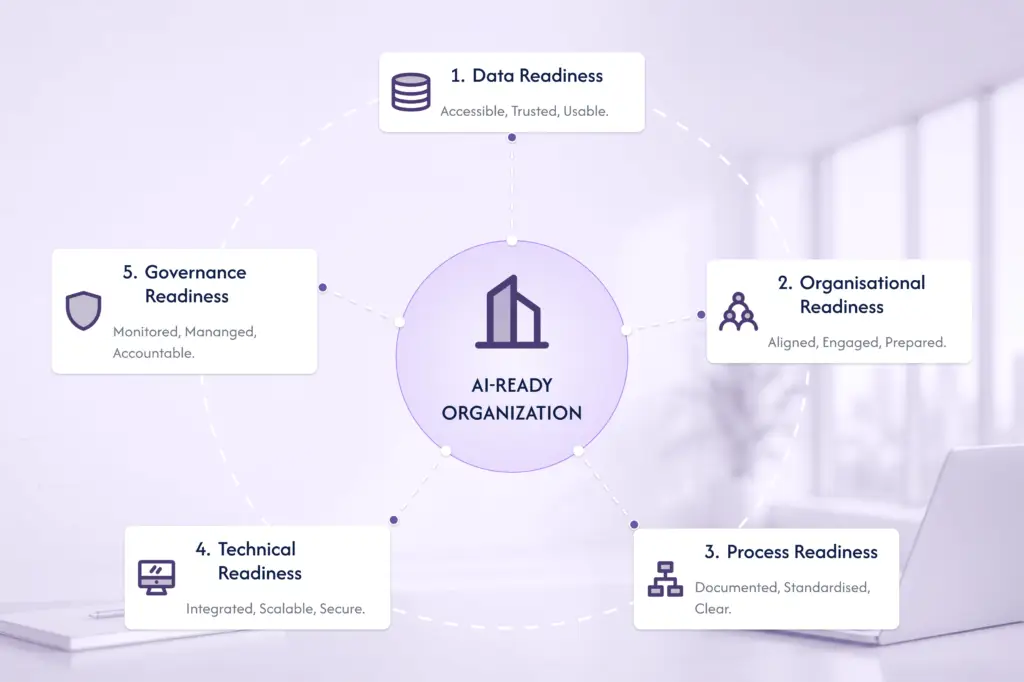
Data Readiness: Can you actually access and use your data?
This is the foundational layer. You need data that is accessible without manual work, documented, and historically stable.
If you’re exporting spreadsheets and cleaning them manually, your data readiness is low. If you have a data warehouse and can query it programmatically, you’re ready for this dimension.
Organizational Readiness: Does your team actually want this?
An AI system will fail if the people using it don’t trust it or don’t understand it. Leadership alignment, end-user buy-in, and realistic expectations are essential.
If you have a single dissenting executive or if your billing team hasn’t been involved in planning, your organizational readiness is low.
Process Readiness: Are your workflows documented?
AI works by automating specific decisions or tasks within your existing workflows. If you don’t know what your workflows actually are, you can’t automate them.
If your processes are ad-hoc and everyone does things their own way, you’re not ready. If you’ve documented the process and identified exactly where AI fits, you’re ready.
Technical Readiness: Can your systems talk to each other?
AI doesn’t exist in a vacuum. It needs to receive input from your existing systems and send recommendations back.
If your systems are completely siloed and integration requires months of work, your technical readiness is low.
Governance Readiness: Will you actually manage the AI?
This is the one everyone skips. But it’s the difference between an AI system that creates value and one that creates liability.
If governance is an afterthought, your governance readiness is low. If you have metrics, monitoring, and procedures in place, you’re ready.
So, Are You AI-Ready?
You’re AI-ready if you can honestly answer “yes” or “we’re actively addressing this” to most questions in these five dimensions.
The good news: if you’re not ready now, you can become ready. Most organizations that systematically assess themselves against these five dimensions can identify their gaps and prioritize fixes within weeks.
The question isn’t whether you’re AI-ready. It’s whether you’re honest about where you stand and willing to do the work to get there.
About btcnxt.ai
btcnxt.ai helps healthcare organizations assess AI readiness across all five dimensions. From data cataloging to governance frameworks, we help you identify gaps and build a roadmap to readiness.
At BTCNXT, we recognize that RCM companies don’t need another subscription login. You need a partner who understands the plumbing of US healthcare. BTC’s experience delivering healthcare software and AI‑driven solutions shows that success requires starting from the operational reality of billing teams, not from generic models or pre‑packaged tools. This means deeply understanding provider workflows, coding nuances, and compliance constraints before choosing algorithms or architecture.We specialize in,