A 67-year-old patient presents to the ED with chest pain and shortness of breath. A physician completes a comprehensive clinical encounter and dictates detailed notes: ‘Patient is a 67-year-old male with significant history of hypertension, type 2 diabetes, and hyperlipidemia presenting with acute onset substernal chest pain radiating to left arm and exertional dyspnea that started three hours ago. Exam reveals elevated BP at 158/92, tachycardia at 102, and mild crackles at bilateral lung bases. EKG shows ST depression in leads II, III, aVF suggesting inferolateral ischemia. Troponin elevated at 2.1 ng/mL. Assessment: Acute coronary syndrome. Plan: Admission to CCU, aspirin 325 mg loading dose, heparin drip initiated, serial EKGs and troponin measurements every three hours, cardiology consultation.’ The clinical notes are perfect. They capture the complete clinical picture in the physician’s own words, clinical reasoning, and professional context. Rich, detailed, nuanced, and—without modern AI—completely inaccessible to your billing system, analytics platform, and quality improvement team.
Until recently, translating those narrative clinical notes into usable structured data required human medical coders reading each note and manually entering standardized fields. A coding department might process 8-10 encounters daily. Every coder must carefully read the note, determine the primary diagnosis code, identify comorbidities, find documented justification for procedures, and enter diagnosis codes, procedure codes, and clinical documentation fields into your billing system. It’s expensive work—coders cost $50-80K annually plus benefits. It’s slow—8-10 charts per day per coder is industry standard. And it’s error-prone. A coder misreads documentation. Misses a comorbidity that has coding significance. Fails to capture clinical justification that prevents a future denial. Most critically, the rich clinical information in the narrative—nuances about patient status, clinical concerns, prognostic indicators—simply vanishes when it’s reduced to billing codes.
Generative AI (GenAI) transforms this completely. Modern LLMs can read clinical narratives and extract specific structured information with 99%+ accuracy—diagnosis codes, documented justification, comorbidities, risk factors, clinical decisions. The system understands context and clinical subtlety the way a skilled human coder does. It recognizes when a physician casually mentions ‘borderline elevated creatinine’ as a potential renal concern. It captures the full clinical richness of the narrative. It processes at machine speed: encounters coded in seconds, not hours. It costs a fraction of human coding—approximately $0.50-$2.00 per encounter versus $15-25 for human coding.
This transformation of clinical data from narrative to structured creates measurable value across three dimensions that directly impact your bottom line: dramatically faster billing cycles, better RCM outcomes with fewer denials, and deeper clinical insights enabling quality improvement and operational optimization.
What Clinical Data Structuring Means and Why It Matters
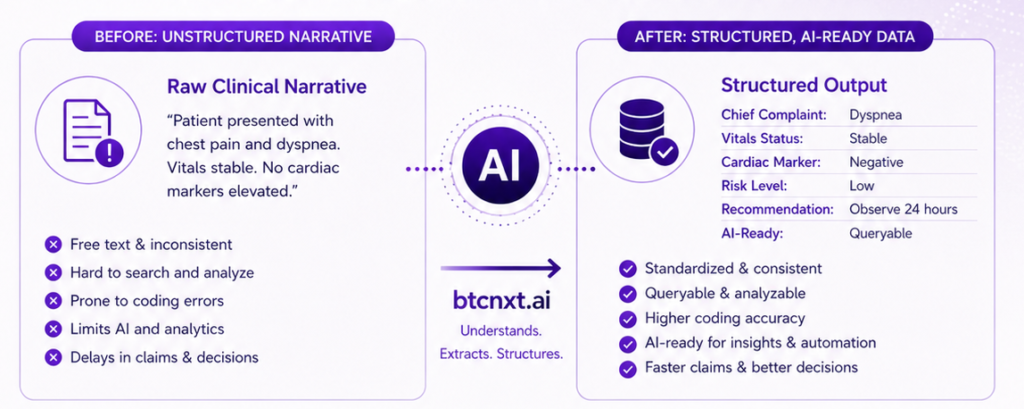
Clinical data structuring converts unstructured narrative clinical data—the rich, contextual text in clinical notes—into structured, queryable fields that downstream systems can use automatically. A narrative note becomes standardized fields: Chief Complaint, History of Present Illness, Vital Signs, Physical Examination, Assessment, Plan, Medications, Procedures, Results, Comorbidities. Why does this distinction matter? Because structured data enables automation, analytics, and intelligence that narrative data cannot support. You cannot analyze 10,000 narrative notes to find all patients with diabetes complicated by chronic kidney disease. You instantly query a structured database. You cannot automatically route claims based on narrative documentation hidden in text. You automatically route based on structured codes. You cannot identify clinical outcome trends across thousands of patients by reading narratives. You run statistical analyses on structured data in seconds. Structured data enables every downstream system to work automatically. Narrative data requires human intervention.

GenAI makes clinical data structuring economically viable at enterprise scale. Traditional human coding or hybrid approaches have labor costs that severely limit scale. GenAI-only approaches work at speeds enabling real-time processing of all clinical encounters, not sampled subsets. More importantly, GenAI captures full context. A note about ‘borderline hypertension with recent family history of stroke’ gets structured not just as a billing code but as a complete risk assessment: ‘HTN diagnosis: borderline; cardiovascular risk assessment: elevated; family history: CVA.’ That context matters for downstream clinical decision-making and population health.
Three Immediate Use Cases With Quantified Value
Use Case 1: Coding Speed and Staff Utilization
A typical large hospital with 250+ beds processes 250,000 annual encounters. At industry standard productivity of 8-10 charts per coder per day, this requires approximately 100 FTE coders. GenAI can pre-code 70-80% of work—generating suggested codes that human coders validate in 30 seconds rather than read and code from scratch in 5-7 minutes. This transforms coders from data entry specialists to quality assurance experts. A health system with 100 coding FTE becomes capable of processing the same volume with 30-40 coders doing quality review instead of 100 doing data entry. At $65K per FTE fully loaded, that’s $3.9-4.6M in annual labor savings. You’re not eliminating coders—you’re redeploying them: some to appeals (higher-value work), some to quality assurance, some to analytics. Freed coding staff can focus on complex cases and high-stakes documentation review.
Speed improvement is equally significant. Instead of being coded 3-5 days after discharge, encounters code immediately. This accelerates your billing cycle. Claims submitted faster means payment received faster. Faster cash flow compounds to significant working capital improvement. A $500M revenue health system with 45-day collection cycle that drops to 30 days improves working capital by $20.8M instantly.
Use Case 2: Denial Prevention and RCM Quality
Many claim denials happen because clinical documentation supporting the service isn’t obvious to the billing system at claim submission. A patient presents to the ED with elevated blood pressure and severe headache. The physician documents: ‘Patient with known hypertension presenting with severe headache, blurred vision, and confusion. BP 195/115. Concern for hypertensive emergency. Recommend hospital admission for management.’ That documentation justifies the ED visit and admission. But if buried in narrative text without structured codes, billing systems might submit questionable claims. GenAI extracts the clinical justification automatically, flags it, ensures it accompanies the claim. Payers see documented medical necessity immediately. Approval rates increase. More proactively, GenAI identifies high-risk claims before submission: missing critical documentation, services requiring un-obtained pre-authorization, diagnosis codes not justifying procedure codes. These route for human review pre-submission, preventing denials rather than requiring appeals.
Financial impact: Reducing your denial rate by 1% on $100M in annual claims equals $1M prevented revenue loss. Industry data suggests GenAI-assisted RCM improves denial rates by 2-4%, generating $2-4M in recovered revenue annually plus $500K-1M from reduced appeals staffing.
Use Case 3: Clinical Insights and Population Health
Once clinical data is structured, analytics become possible at enterprise scale. Identify patient cohorts with specific conditions complicated by comorbidities who are high-risk for readmission. Find which clinicians’ patients have better outcomes. Spot procedures with unexpected complication rates. Create population health registries for specific diseases enabling proactive intervention. Example: Structured data enables identifying all diabetic patients with A1C > 9.0 and no endocrinology referral. Flag them for outreach. Intensive management prevents complications costing $50K-150K per occurrence. Preventing 10 complications annually creates $500K-1.5M in value.
Getting Started: Implementation Strategy
You don’t implement clinical data structuring system-wide immediately. That creates project failure and staff resistance. Pick one high-value use case with clear pain points. Maybe it’s your busiest department with the most coding backlog. Maybe it’s where denial rates are highest. Maybe it’s where manual processes are most painful. Implement GenAI-powered structuring for that department. Measure meticulously: coding speed, accuracy, denial rates, staff feedback, quality validation requirements. Document what works. Optimize based on real-world performance.
Once proven, expand to the next department. Each rollout is faster and cheaper because you’ve learned patterns. Within 6-12 months, you’ve covered highest-value departments. Within 24 months, you can be system-wide. Most organizations see ROI within 6-9 months from first implementation, driven purely by coding labor savings and improved claim outcomes.
About btcnxt.ai
btcnxt.ai helps healthcare organizations assess AI readiness across all five dimensions. From data cataloging to governance frameworks, we help you identify gaps and build a roadmap to readiness.
At BTCNXT, we recognize that RCM companies don’t need another subscription login. You need a partner who understands the plumbing of US healthcare. BTC’s experience delivering healthcare software and AI‑driven solutions shows that success requires starting from the operational reality of billing teams, not from generic models or pre‑packaged tools. This means deeply understanding provider workflows, coding nuances, and compliance constraints before choosing algorithms or architecture.We specialize in,