A clinical leader presents their AI initiative to the executive team. The pilot results look promising. The technology vendor’s demo is impressive. The proposed scale-up plan is ambitious. Halfway through the presentation, the CFO asks a question that nobody on the project team can answer well: ‘When you say AI will improve our denial rate, does the AI actually have access to the clinical documentation that justifies our claims, or are we just analyzing the billing codes that already exist?’ Silence. The honest answer is that they don’t really know. The AI has access to whatever’s in the structured fields of the EHR—diagnosis codes, lab values, vitals. The clinical reasoning that explains why a service was medically necessary lives in the narrative notes the physician dictated. Whether the AI can read those notes depends on whether the data has been structured, and that’s not a question anyone on the project team thought to ask.
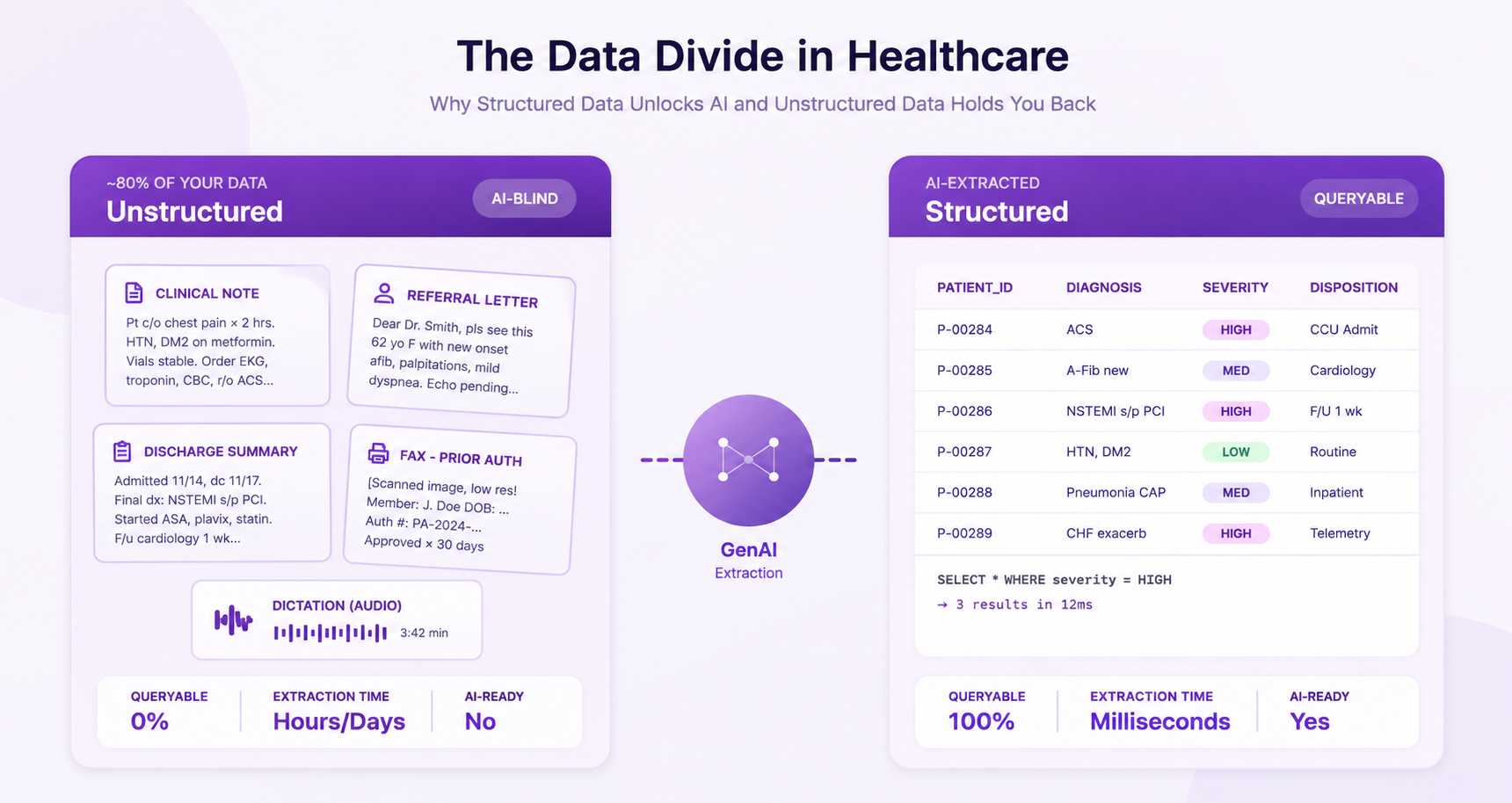
This is one of the most important and least understood distinctions in healthcare AI. The difference between structured and unstructured clinical data determines what AI can and cannot do at your organization. Most healthcare leaders don’t appreciate how dramatic the difference is, and most AI initiatives underdeliver because they’re built on the assumption that all data is equivalent. It isn’t. The 20% of your clinical data that’s structured is fundamentally different from the 80% that’s unstructured, and the AI implications of that 80/20 split shape everything from ROI to deployment timelines.
This article explains both data types in practical terms, why the distinction matters more than most realize, and what changes when you bridge the divide using modern GenAI. By the end, you’ll be able to ask the right questions of vendors and the right questions of your own data team.
What Structured Data Actually Is
Structured data lives in defined fields with consistent formats. A patient’s date of birth is a date. Their diagnosis code is a string from a controlled vocabulary like ICD-10. Their blood pressure is two numbers separated by a slash. Their medication list is a series of entries with name, dose, frequency, and route. Each piece of information has a designated place in your database with rules about what it can contain. This makes structured data fast to query, easy to analyze, and ready for nearly any AI system. You can ask your database ‘how many diabetic patients with A1C above 9 do we have’ and get an answer in milliseconds. You can feed structured data into machine learning models with minimal preprocessing. You can build dashboards, alerts, and population health programs on structured data because the data is predictable and queryable.
The downside of structured data is what it can’t capture. Clinical reality doesn’t fit neatly into predefined fields. A patient with ‘borderline elevated creatinine but stable kidney function on long-term metformin with planned cardiology workup’ has a clinical picture that no checkbox or dropdown adequately represents. Structured fields force clinicians to reduce nuanced clinical reasoning into discrete categories, losing context in the process. This is why structured data is reliable but incomplete; it tells you what is officially documented but not what’s clinically understood.
GenAI makes clinical data structuring economically viable at enterprise scale. Traditional human coding or hybrid approaches have labor costs that severely limit scale. GenAI-only approaches work at speeds enabling real-time processing of all clinical encounters, not sampled subsets. More importantly, GenAI captures full context. A note about ‘borderline hypertension with recent family history of stroke’ gets structured not just as a billing code but as a complete risk assessment: ‘HTN diagnosis: borderline; cardiovascular risk assessment: elevated; family history: CVA.’ That context matters for downstream clinical decision-making and population health.
What Unstructured Data Actually Is
Unstructured data is everything that doesn’t fit in structured fields: physician narrative notes, dictated progress notes, scanned documents, faxes, referral letters, discharge summaries, radiology reports, pathology reports, and the vast collection of clinical communication that defines how care actually happens. This data captures the full clinical picture in human language. It contains the reasoning behind decisions, the nuances of clinical judgment, the context that makes structured data meaningful. The discharge summary doesn’t just list the discharge diagnosis; it explains why that diagnosis was made, what alternatives were considered, what the response to treatment was, and what the follow-up plan is. None of that fits in structured fields, but all of it matters.
The challenge with unstructured data is that traditional systems can’t read it. To a database, a clinical note is just a string of text. The database can search for specific words but cannot understand what they mean in context. ‘Pain rated 8/10’ and ‘no significant pain’ both contain the word ‘pain’ but mean opposite things. Traditional analytics systems either ignore unstructured data entirely or rely on human coders to read it and translate it into structured fields. This is expensive, slow, and incomplete. The coder captures the billable codes and misses everything else.
The 80/20 split is consequential. If 80% of your clinical data is unstructured and your AI can only read structured data, your AI is making decisions based on 20% of the picture. Predictions are less accurate. Population health is incomplete. Denial prevention misses the documentation that would have justified claims. Every analytics initiative is operating with a 20% view of clinical reality.
Why the Difference Matters for AI Outcomes
When AI is built on structured data alone, several predictable problems emerge. Denial prevention is weak because the AI cannot see the clinical justification that lives in narrative notes. Risk stratification is incomplete because the clinical nuances that predict outcomes are buried in text the AI can’t read. Population health programs miss patients because the relevant clinical conditions aren’t reflected in their structured data—the physician documented the concern in the note but didn’t code it as a billable diagnosis. Quality improvement initiatives are limited because they can only measure what’s structured, missing the qualitative dimensions of care.
Conversely, when AI can also access unstructured data, it operates on the full clinical picture. Denial prevention examines both billing codes and narrative justification, catching gaps before submission. Risk models incorporate clinical reasoning, not just discrete data points. Population health identifies all relevant patients, including those whose conditions live primarily in narrative documentation. Quality improvement measures clinical reality, not just what fit in structured fields. The same AI investment generates dramatically more value when it has access to all the data, not just the structured subset.
How GenAI Bridges the Divide
This is where modern generative AI changes the equation. GenAI models can read clinical narratives with human-level comprehension and extract structured information from them. A discharge summary that previously required human coding to translate becomes immediately accessible to your analytics systems. The diagnoses, comorbidities, procedures, medications, risk factors, and clinical reasoning that were trapped in narrative form become structured fields that downstream AI can use. This isn’t just transcription or keyword search. GenAI understands context, resolves ambiguity, captures clinical nuance, and produces structured output that reflects the full clinical picture rather than just the billable codes.
The economic implications are significant. The same physician note that previously generated $20-30 of billing codes through human coding now generates a comprehensive structured representation that enables AI use cases across denial prevention, population health, quality improvement, and clinical decision support. The marginal cost of GenAI extraction is approximately $0.50-2 per document versus $15-25 for human coding. The value generated is multiples higher because the extracted data feeds multiple downstream AI use cases rather than just billing.
What This Means for Your AI Strategy
If you’re evaluating AI initiatives, the structured-vs-unstructured question should be one of the first you ask. What data sources does this AI access? If only structured fields, what percentage of clinically relevant information is the AI missing? Does the solution include GenAI extraction from unstructured sources, or only analysis of pre-structured data? Vendors who can’t answer these questions clearly are usually selling solutions that work in pilots and underdeliver at scale. Solutions that include GenAI extraction as a foundation layer—structuring unstructured data so downstream AI can use it—deliver dramatically better outcomes because they operate on the complete clinical picture rather than the structured subset. The strategic insight is that data structuring is foundational infrastructure, not an isolated use case. Investing in GenAI extraction creates a multiplier effect across every other AI initiative your organization pursues. Your denial prevention, risk modeling, population health, and quality improvement all become substantially more effective because they all draw from the same structured representation of complete clinical data. This is what separates AI investments that compound from AI investments that plateau.
About btcnxt.ai
At BTCNXT, we implements GenAI extraction infrastructure that bridges the structured-unstructured divide in healthcare data. We help organizations unlock the 80% of clinical data that’s invisible to traditional AI, creating the foundation that makes every downstream AI initiative dramatically more effective.
BTC’s experience delivering healthcare software and AI‑driven solutions shows that success requires starting from the operational reality of billing teams, not from generic models or pre‑packaged tools. This means deeply understanding provider workflows, coding nuances, and compliance constraints before choosing algorithms or architecture.We specialize in,