A health system CFO opens her monthly denial report and finds the same picture as last month, and the month before. Denial rate hovering around 11%. Appeal backlog growing. The same payers denying the same kinds of claims for the same reasons. The same staff fighting the same fights. The board has approved an AI investment to address this, but as she reads vendor proposals, she notices the pitches sound interchangeable. Everyone promises ‘AI-powered denial management.’ Everyone shows a dashboard. Everyone cites case studies. What none of them clearly explains is what their AI actually does, when in the claim lifecycle it acts, and why that timing changes the economics of the entire problem.
This is the gap most denial-related AI conversations have. The technology exists; the mechanics are well-understood; the outcomes are reproducible. But healthcare leaders are buying it without understanding what they’re buying, and as a result, they end up with expensive resolution capabilities when they needed cheaper prevention capabilities, or vice versa. The difference between an AI investment that reduces denials by 40% and one that produces a marginal improvement isn’t the model. It’s whether the AI is deployed at the right point in the workflow.
There are two fundamental approaches: prevention, which acts before a claim is submitted, and resolution, which acts after a claim is denied. Each addresses a different part of the problem with a different cost structure and a different success profile. Understanding both — and the order in which to deploy them — is the difference between an AI program that compounds value and one that plateaus.
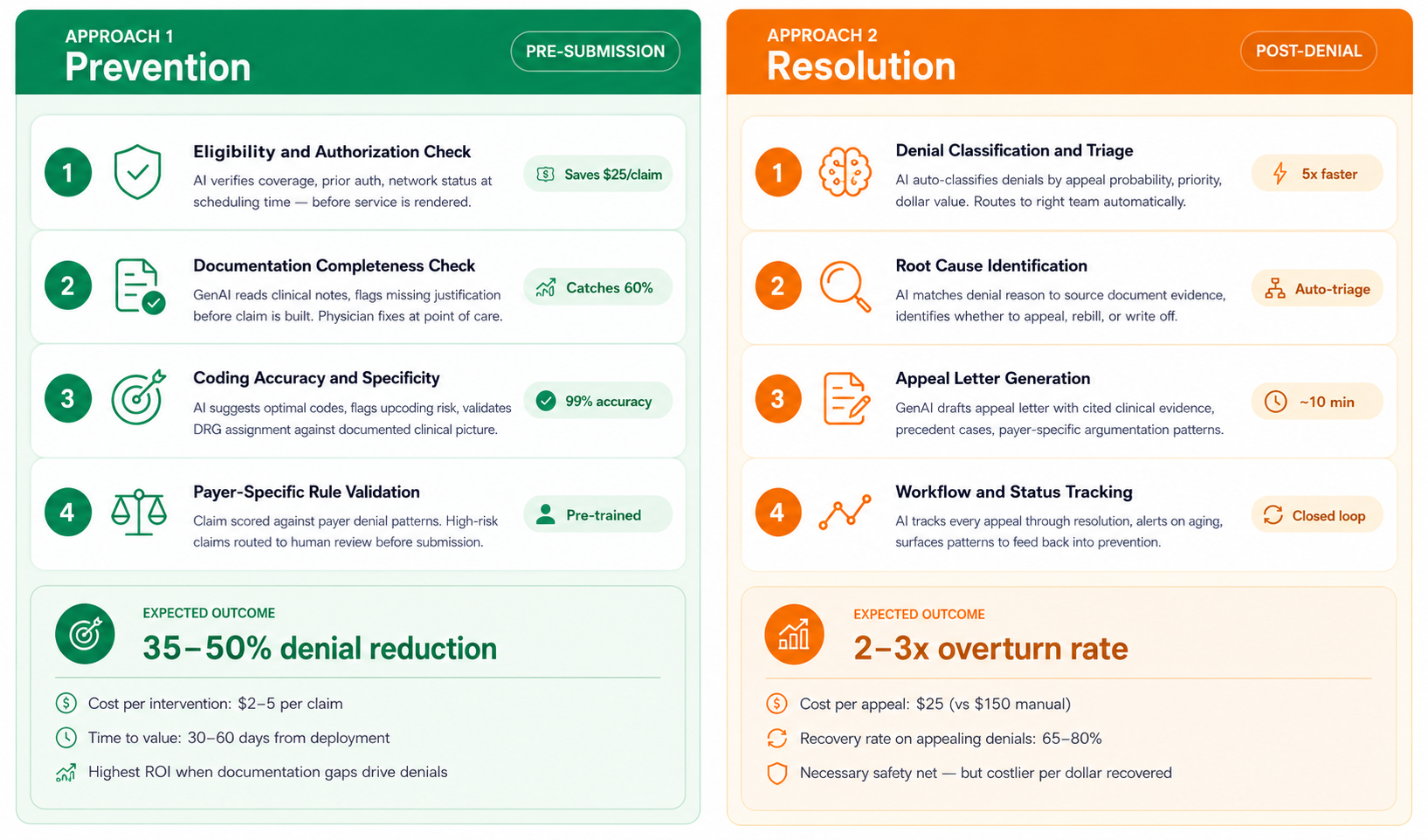
Prevention: Four Stages Where AI Acts Before Submission
Prevention AI operates on a single principle: the cheapest denial to fix is one that never happens. Every denied claim costs your organization somewhere between $25 and $150 in labor to work through, regardless of whether you ultimately recover the revenue. Preventing that denial in the first place costs $2 to $5 per claim in AI processing. The economics are not subtle. But prevention only works if the AI is positioned at the points in your workflow where errors are introduced, which means deploying at four specific stages.
Stage one is eligibility and authorization verification, which happens at scheduling. When a patient is scheduled for a service, AI checks their coverage against the payer’s current rules, verifies network status, confirms whether prior authorization is required, and either initiates the authorization or flags the encounter for human follow-up. This sounds basic, and the basic version has existed for years. What modern AI adds is the ability to understand payer-specific authorization patterns that change quarterly, to predict which services will require authorization even when the rules are ambiguous, and to draft authorization requests automatically using clinical justification extracted from the referring physician’s note. Eligibility-stage prevention catches the denials that should never have been claims in the first place — denials for non-covered services, out-of-network providers, or missing prior authorization.
Stage two is documentation completeness, which happens at the point of care or shortly after. A physician dictates or types a clinical note. Before that note is closed, generative AI reads it and asks a specific question: does this note contain the clinical justification needed to support the services that will be billed for this encounter? If the answer is no, the AI flags the gap and gives the physician specific guidance on what’s missing while the patient is still fresh in their memory. A note that mentions chest pain without documenting the cardiac workup will get flagged. A note that bills for a level-five visit but documents level-three complexity will get flagged. The fix happens in seconds, while the encounter is still open, by the only person who actually knows what was clinically true: the physician. Once that note closes and the patient leaves, fixing the gap requires addendums, queries, and weeks of cycle time.
Stage three is coding accuracy and specificity, which happens during the bill build. The documentation now exists; the question is whether it’s being translated into the right codes. AI coding assistance reads the clinical narrative and recommends optimal codes — not necessarily the highest-paying codes, but the codes that most accurately reflect what was clinically documented. This protects against two opposite problems: undercoding (leaving money on the table because coders defaulted to simpler codes) and upcoding (assigning codes the documentation doesn’t actually support, which creates compliance risk and predictable denials). A well-trained AI coder achieves accuracy rates above 99% on routine encounters and consistently outperforms human coders on edge cases because it doesn’t get tired, doesn’t miss a comorbidity in a long note, and applies coding rules uniformly across millions of cases.
Stage four is payer-specific rule validation, which happens immediately before submission. By this point the documentation, coding, and authorization should all be in order. AI does one final pass: it scores the assembled claim against the historical denial patterns of the specific payer it’s about to be submitted to. Different payers deny different things. A claim that sails through Payer A might trigger a Payer B’s automated edits. The AI learns these patterns from your own historical denial data and external industry benchmarks, then assigns a risk score to each claim before it goes out the door. High-risk claims get routed to human review. Low-risk claims submit automatically. The result is that obvious problems are caught before submission, and the human reviewers focus their time on the claims most likely to fail.
Resolution: Four Stages Where AI Acts After Denial
No prevention system catches every denial. Even with mature prevention AI in place, you’ll still have denials — payer policy changes, edge cases, documentation that legitimately couldn’t be improved, claims that were correctly billed but got denied anyway. For these, resolution AI takes over, with its own four-stage architecture. Resolution is more expensive than prevention per intervention, but it’s still dramatically cheaper than the alternative, which is either writing off the denial or paying staff to manually appeal it.
Stage one is denial classification and triage. Every morning, your denials come in as a flood of reason codes from multiple payers. Some are administrative (missing data, easily fixed); some are clinical (medical necessity disputes, harder to fix); some are technical (coding errors, fixable with a rebill); some are not worth appealing at all (claim values too low, success probability too low). AI reads each denial within minutes of receipt, classifies it by type, scores its appeal probability based on historical outcomes for that denial reason with that payer, calculates the dollar value at stake, and routes it to the right queue. What used to take a denial supervisor a half-day of sorting now happens before anyone arrives in the morning. The right denials get to the right people in priority order.
Stage two is root cause identification, which is where most manual appeal processes fall down. A denial says ‘medical necessity not established.’ Your appeals specialist has to dig through the chart to figure out what evidence exists, what the payer’s specific medical necessity criteria are for this service, and whether the evidence meets the criteria. AI compresses this to seconds. It reads the entire chart, extracts every piece of evidence relevant to the denial reason, compares the evidence against the payer’s published criteria, and produces a structured summary: appealable with strong evidence, appealable with weak evidence, not appealable, or rebill-and-resubmit. The specialist starts the appeal with the analysis already done.
Stage three is appeal letter generation, the work that traditionally consumes hours per appeal. Generative AI drafts the appeal letter using a structured template, populated with the specific clinical evidence extracted from the chart, supported by relevant precedent (similar appeals that succeeded with this payer), formatted in the payer’s preferred argumentation style. The first draft is typically 80-90% of what the final letter looks like. The appeals specialist reviews, edits if needed, and submits. What used to take 60-90 minutes per appeal now takes 10-15 minutes. Volume of appeals doubles or triples without adding headcount.
Stage four is workflow tracking and pattern learning, which closes the loop. Every appeal is tracked through resolution: how long it took, who handled it, whether it succeeded, and why. Aging appeals get alerts before they hit deadlines. Patterns emerge over time — this payer is denying these services in this volume, these are the appeal arguments that work, these are the denial reasons that aren’t worth appealing. The patterns feed back into the prevention stage. The denials you successfully appeal this month become the rules your prevention AI uses to stop the same denials from occurring next month. This closed loop is what turns AI from a point solution into a learning system.
The Cost Economics That Determine Sequencing
The math behind sequencing is straightforward when you put real numbers to it. Preventing a denial at the eligibility or documentation stage costs your AI system roughly $2-5 per claim processed. Resolving a denial after it occurs costs roughly $25 per appeal in AI plus human review time — and that’s the AI-assisted cost, down from $100-150 for fully manual appeals. Writing off a denial costs the full contracted value of the claim. So the cost gradient is clear: prevent for $3, resolve for $25, write off for $400. Every claim you move up that ladder saves an order of magnitude.
This is why prevention deserves to come first when sequencing your AI rollout, but most organizations get this backwards. They start with resolution because it’s more visible — appeal volumes are tracked, denial rates are reported, the pain is acute and observable. Prevention is invisible by definition: a claim that never denies generates no headline. So leaders deploy AI to handle the appeal backlog first, achieve impressive resolution metrics, and then run out of budget before they get to prevention. Six months later they have a sophisticated appeal factory and the same denial rate they started with. The denials get resolved faster, but they keep coming.
The right sequence is prevention first, resolution second, closed-loop learning third. Deploy documentation completeness and coding accuracy AI in your top one or two service lines. Reduce denials in those service lines by 30-40% within 90 days. Use those savings to fund resolution AI for the denials that still happen. Then connect the systems so that resolution patterns inform prevention rules. By month 12, your top service lines have denial rates in the low single digits, your appeal volumes are dropping rather than growing, and your AI program has paid for itself multiple times over.
Where Implementations Go Wrong
Three patterns predict failure in denial AI implementations. The first is deploying prevention AI without changing the workflow it sits in. If your documentation completeness AI flags a gap but the physician doesn’t see the alert until the next day, or sees it but has no easy way to address it, the AI generates noise rather than value. Prevention only works when the alert reaches the right person at the right moment with a clear path to action. The second pattern is treating the AI’s output as the final answer rather than a starting point. The best AI denial systems augment human judgment; they don’t replace it. Organizations that try to run fully automated denial workflows discover that the edge cases that fail are exactly the high-value cases they couldn’t afford to lose. The third pattern is failing to invest in the data foundation. AI prevention relies on access to clinical documentation, payer rules, and historical denial patterns. If your data is fragmented across systems or locked in unstructured formats, your prevention AI is operating with a partial view of reality. Most healthcare AI denial failures trace back to data infrastructure problems, not AI capability problems.
Where to Start in the Next 90 Days
Pick one service line where denials are concentrated, the denial reasons are well understood, and your clinical documentation is reasonably complete. This is usually a high-volume service like cardiology, oncology, or orthopedics — not because they have the worst problems, but because they have enough volume to generate meaningful results quickly. Deploy documentation completeness and coding accuracy AI for that service line first. Measure denial rates, appeal volumes, and revenue recovered weekly. Within 90 days you should see denial rates drop 25-40% in that service line. Within 180 days, the same approach can be extended to your next two or three service lines. Within 12 months, denial AI is part of your standard operating model across the organization, your denial rate has compressed by half, and the conversation has shifted from ‘how do we work the appeal backlog’ to ‘how do we deploy AI in the next part of the revenue cycle.’ That shift — from defense to offense — is what AI is supposed to deliver in RCM, and it’s why getting the mechanics right matters more than the brand of model you choose.
About BTCNXT
BTCNXT builds prevention-first AI denial management systems for healthcare organizations. From documentation completeness AI to payer-specific risk scoring to closed-loop appeal learning, we help RCM leaders shift from working the denial backlog to eliminating denials at the source. We specialize in,