Every healthcare CIO faces this decision at some point. Your legacy systems work, but they’re showing their age. Your EHR was implemented a decade ago. Your billing platform predates the current revenue cycle landscape. Your data lives in silos that integration teams have stitched together with custom interfaces over years. A vendor pitches you on a complete platform replacement—new EHR, new billing, new analytics, all integrated, all modern. The pitch is compelling. The price tag is staggering. Your board wants to know if this is the right call. Meanwhile, another vendor pitches you on adding an AI layer on top of your existing systems—keeping what works, modernizing what doesn’t, deploying capability incrementally. Same outcome, allegedly, at one-tenth the cost. The pitch is also compelling. The price tag is reasonable. But is it actually equivalent?
These two paths are not equivalent in their outcomes, their risks, or their organizational impact. The decision between them is one of the most consequential a CIO will make, and most of the failed healthcare technology projects of the last decade resulted from choosing the wrong path for the wrong reasons. Rip-and-replace fails most often. Integration succeeds most often. But the right answer depends on your specific situation, and choosing well requires a structured framework rather than vendor-driven enthusiasm.
This article gives you that framework: the criteria that should drive the decision, the metrics that matter, the risks each path carries, and the situational factors that should tilt your choice one way or the other. By the end, you’ll know which path fits your organization and why.
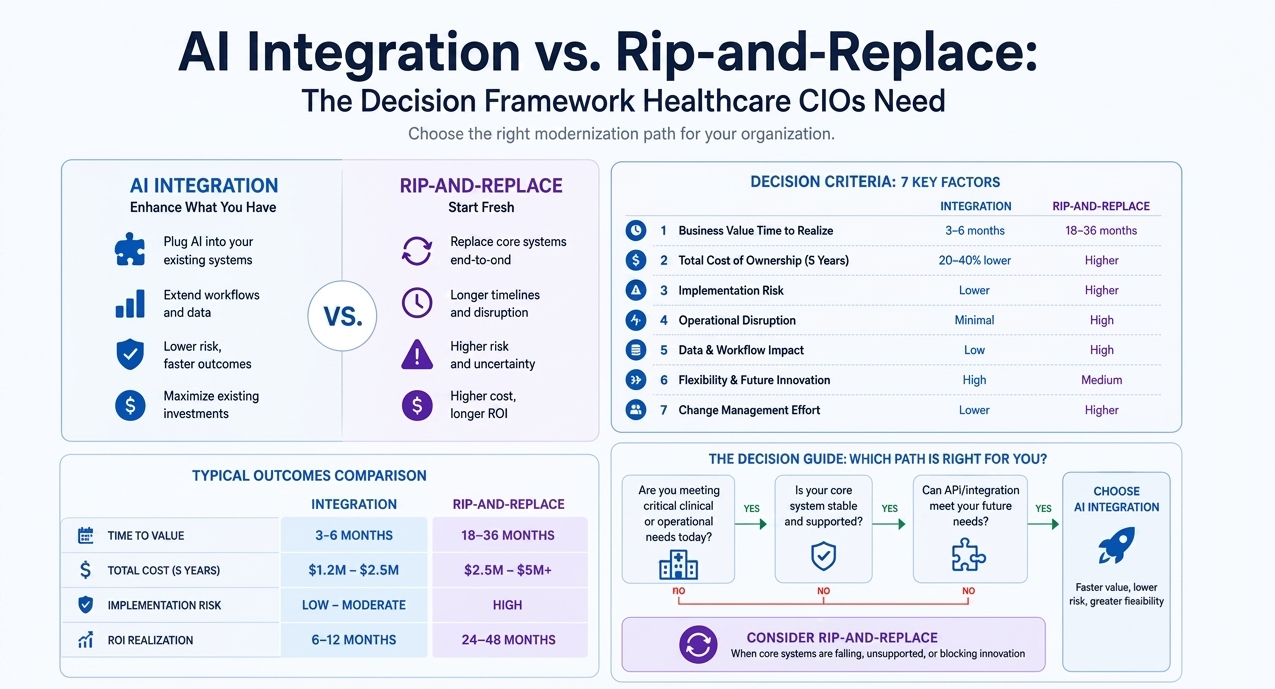
The Brutal Math of Rip-and-Replace
Major healthcare technology replacements—particularly EHR replacements—have a track record that vendors don’t put on their slide decks. Industry data from the past decade shows that healthcare EHR replacements typically come in 2-3x over budget, run 18-36 months longer than planned, and produce productivity drops of 30-50% during transition that persist for 6-18 months after go-live. A meaningful percentage of these projects—estimates range from 30% to 50%—are either cancelled before completion or considered failures by their sponsoring organizations after completion. The capital required is substantial: $50M-200M for a mid-sized health system, $500M+ for large integrated systems.
Why are the outcomes so poor when so much capital and talent is committed? Because healthcare operations cannot pause. Your patients keep arriving. Your bills keep needing to go out. Your clinicians keep needing to document. A rip-and-replace forces you to maintain operations while simultaneously rebuilding the systems those operations depend on. This is enormously hard. Staff burn out. Workarounds proliferate. Quality issues emerge. The temptation to deploy before ready is intense because every month of delay costs millions in continued legacy maintenance and lost productivity. Many organizations deploy systems that aren’t ready, then spend years stabilizing them.
There are situations where rip-and-replace is the right answer. If your legacy systems are genuinely failing—vendor support ended, security vulnerabilities can’t be patched, clinical safety issues are emerging—you may have no alternative. But these situations are rare. Most legacy systems work; they just don’t work well. That’s a different problem with a different solution.
Why AI-Powered Integration Works Better
AI-powered integration takes a fundamentally different approach. Rather than replacing legacy systems, you add an AI orchestration layer above them. This layer reads from and writes to existing systems through modern APIs, handles workflows that span multiple systems, structures unstructured data, and provides the unified data foundation that enterprise AI needs. Your legacy systems continue to do what they do well. The AI layer provides the modern capabilities they lack. New AI use cases plug into the integration layer rather than requiring custom integration with multiple back-end systems.
The economic profile is dramatically different. Capital requirements are typically $2M-15M rather than $50M-200M. Time to first value is 6-12 months rather than 3-5 years. Operational risk is contained because legacy systems keep running; if something goes wrong with the new AI capability, you fall back to the existing process without patient impact. Each workflow can be deployed independently, evaluated, refined, and scaled before the next one starts. ROI compounds because the integration layer becomes more valuable with each additional use case it supports, rather than depreciating like new systems.
The implementation pattern is incremental. Quarter one: pick one high-value workflow, build the integration, deploy the AI capability, measure results. Quarter two: refine based on learning, then start workflow two. Quarter three: workflow three begins while workflow one and two operate at scale. By the end of year one, you have 3-4 workflows operating with AI augmentation. By the end of year two, you have 8-12. The pace and value accelerate with experience rather than collapsing under complexity.
The Decision Framework: Six Questions That Determine the Right Path
The choice between integration and replacement should be driven by six specific questions. First: are your legacy systems functionally working, or are they actually failing? Functional systems with fragmentation issues are integration candidates. Failing systems may require replacement. Second: how much disruption can your clinical operations tolerate? Organizations that cannot tolerate any clinical disruption should default to integration. Third: what’s your appetite for multi-year capital commitment? Organizations that need ROI within 24 months should choose integration. Fourth: how complex is your operational footprint? Multi-location organizations particularly benefit from integration because replacement complexity scales geometrically with location count. Fifth: what’s your change management capacity? If your organization struggled with smaller changes, replacement will overwhelm it. Sixth: how strategic is the technology to your differentiation? If your EHR is a commodity, integration makes sense. If it’s a strategic capability, replacement may be justified.
Five or six ‘integration’ answers point clearly to that path. Five or six ‘replacement’ answers—rare in our experience—point to that path. Mixed answers usually still favor integration because it offers a way to validate the strategy before committing to full replacement. You can always replace later if integration proves insufficient. You cannot un-replace easily.
The Hidden Costs Vendors Don't Mention
Both paths carry costs that don’t appear in initial vendor pitches. For rip-and-replace, the headline price is typically only 40-50% of the true total cost. Implementation services, data migration, integration with systems that aren’t being replaced, training across thousands of staff, productivity loss during transition, and post-go-live stabilization typically double the original number. The 36-month transition also means 36 months of running both old and new systems in parallel—paying maintenance on legacy systems you’re trying to retire while paying for the new platform you haven’t yet stabilized. For integration, the costs are smaller but still real: integration engineering for each new workflow, ongoing operational support for the AI layer, governance and monitoring infrastructure, and the inevitable need to modernize portions of legacy infrastructure that turn out to be too brittle to integrate with. The right comparison isn’t sticker price to sticker price. It’s total cost of ownership across the planning horizon you actually care about, including the opportunity cost of capital tied up in long transitions versus capital deployed into productive AI use cases. When the comparison is done honestly, integration’s total cost advantage typically widens, not narrows.
When Integration Beats Replacement Definitively
Several situations make integration the unambiguous choice. Multi-location healthcare organizations operating 5+ facilities almost always benefit from integration over replacement because rolling out a new platform across multiple locations multiplies disruption and risk. Organizations with significant unstructured data—which describes virtually all healthcare—benefit from integration because AI can extract value from existing narrative data without requiring data to be re-entered into new systems. Organizations facing competitive pressure that requires near-term ROI cannot afford the 3-5 year payback period of replacement; they need integration’s 6-12 month cycle. Organizations that have already been through a difficult system transition recently and have change-management fatigue cannot absorb another one; integration delivers capability without the change burden. The pattern is consistent: integration delivers more value, faster, with less risk, for the vast majority of healthcare organizations. The exceptions—where replacement is genuinely the right call—are uncommon and usually obvious when they occur. Default to integration unless you have a specific, compelling reason to choose otherwise.
About BTCNXT
BTCNXT builds AI-powered integration architectures that modernize healthcare operations without rip-and-replace risk. From discovery and decision framework through workflow-by-workflow deployment, we help CIOs deliver enterprise AI capability while keeping clinical operations running.
We specialize in,