A prior authorization request lands in a healthcare organization’s inbox at 9:14 in the morning. It arrived by fax, was auto-scanned by the multifunction printer, and now sits as a PDF in a shared drive labeled ‘Auth Requests – Unprocessed.’ By 4:47 that afternoon, if things go well, a human being will have opened the PDF, read it, typed the relevant information into the intake system, made a decision about how to route it, and moved it into the next queue. If things go badly, it sits for two more days because the intake team is behind. If things go really badly, it is misfiled, forgotten, or lost. All of this happens to millions of documents every day inside healthcare organizations, and the collective cost is enormous: staff time, cycle time, error rate, missed deadlines, denied claims, delayed care.
For twenty years, the industry response to this problem has been optical character recognition. Point OCR at a scanned document, get back a searchable text file, and let humans work from that instead of the raw scan. This helped, marginally. It made documents searchable and made keyword-based routing possible. It did not change the fundamental problem, which is that a human being still needs to read the document to understand what it means and what should happen next. OCR made documents easier to search. It did not make them easier to act on.
Modern intelligent document processing is different in kind, not just degree. IDP does not just extract characters; it extracts meaning, context, and action. It takes a fax that would have taken a human 15 minutes to process and turns it into a decision-ready structured record in seconds. Understanding how this works and why it required an entirely new architecture rather than better OCR, is what separates buyers who get value from IDP investments from buyers who end up with expensive OCR by another name.
Layer 1: OCR — Where the Old World Ends
OCR is not obsolete; it is a component of IDP. Every IDP pipeline still needs OCR at the very bottom to convert the pixels of a scanned image into a stream of characters. Modern OCR is dramatically better than what existed a decade ago. It handles poor-quality scans, mixed fonts, handwriting in some cases, forms with complex layouts, and stamped or annotated documents that would have defeated older engines. What it produces, however, is exactly what it always produced: a text file. That text file has no notion of what the document is, what fields are in it, what those fields mean, what the relationships between them are, or what should happen next. To a system consuming OCR output, a prior authorization request and a grocery receipt are equally opaque strings of characters.
This is why buying OCR and hoping it will drive automation almost never works. Once the character stream exists, a human being still has to read it, understand it, extract the relevant fields, decide what type of document it is, and route it accordingly. OCR made the reading fractionally faster because the text is searchable. It did not change the fact that reading was still happening. The organizations that invested in OCR expecting operational transformation and got only marginal efficiency gains were not wrong about OCR. They were wrong about where the value lives, which is in the layers above.
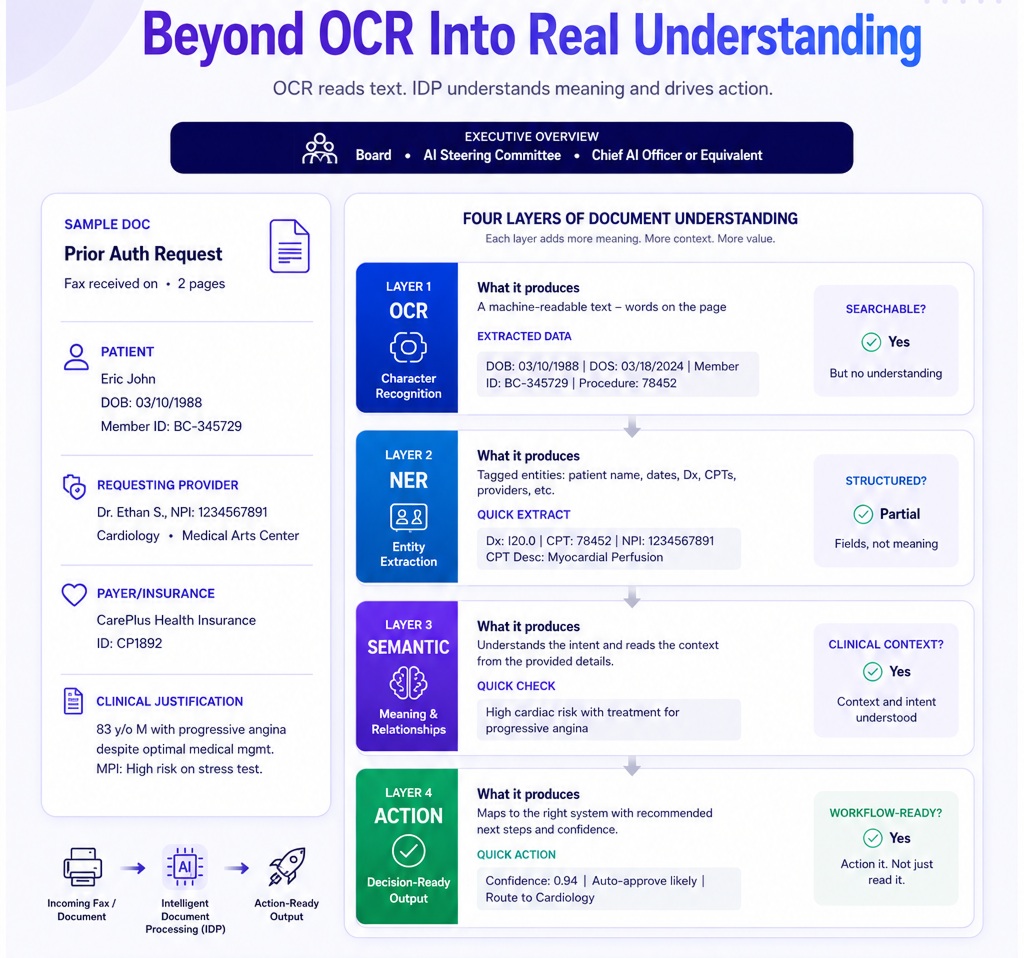
Layer 2: Entity Extraction — Turning Characters Into Fields
The second layer of IDP is named entity recognition, or NER. Given the character stream from OCR, NER identifies which spans of text represent specific types of entities — patient names, dates of birth, medical record numbers, CPT codes, ICD-10 codes, provider NPIs, insurance member IDs, dollar amounts, drug names, and dosages. Each recognized entity gets tagged with its type. The output is no longer just text; it is text with structure. A prior authorization request now contains an identified patient, an identified requesting provider, an identified service being requested, and an identified insurance policy.
This is the layer where most first-generation intelligent document processing tools stopped. It is a meaningful improvement over OCR. Systems can now search for specific field types, populate intake forms automatically, and flag documents that lack required fields. But NER-only systems still have a fundamental limitation: they know what fields are in the document, but they do not understand what the document is saying. They can tell you that Patient X is having Service Y requested by Provider Z. They cannot tell you whether Service Y is medically justified by the clinical context in the note, whether Provider Z is authorized to request it, or whether this request is likely to be approved. That understanding requires the layers above.
Layer 3: Semantic Understanding — Meaning and Relationships
The third layer is where generative AI transforms IDP. Semantic understanding takes the extracted entities and interprets what they mean in relation to each other and to the document as a whole. A cardiac catheterization requested for a 62-year-old male with progressive angina, a positive stress test from the previous week, and documented risk factors is a very different clinical picture than a cardiac catheterization requested for a 45-year-old female with atypical chest pain, an equivocal stress test, and no risk factors. Both documents contain the same CPT code. Both contain the same requesting provider type. Layer 2 systems treat them as equivalent. Layer 3 systems understand that the first request has strong clinical justification while the second is likely to be questioned by the payer.
This is what modern large language models bring to document processing. They read the narrative context, they interpret the clinical reasoning, they understand the relationships between fields, and they produce structured output that reflects meaning rather than just presence. The output of a Layer 3 system is not just ‘CPT 93458 requested for patient P-284729.’ It is ‘cardiac catheterization requested for progressive angina with positive stress test — clinical justification present and adequate for typical payer criteria.’ The difference is enormous, because the downstream workflow now has enough understanding to make an actual decision, not just to file the document.
Layer 4: Action — Decision-Ready Output
The fourth and final layer is where IDP actually earns its keep. Given the semantic understanding of the document, the system produces a decision-ready output: what type of document is this, which downstream workflow should handle it, what next step is recommended, and how confident is the system in that recommendation. A prior authorization request with strong clinical justification, a valid provider, and coverage in place gets routed to auto-approval with a confidence score of 0.94. A prior authorization request with ambiguous justification gets routed to human review with an explanation of what is ambiguous. A document that turns out not to be a prior authorization request at all — a fax cover sheet, a marketing letter, a misdirected communication — gets routed to a triage queue with the reason for the reclassification.
The confidence score matters more than most buyers appreciate. A well-designed IDP system does not produce a binary approve-or-reject decision. It produces a graded output that lets the operation calibrate how much human involvement is needed. High-confidence documents flow through automatically. Medium-confidence documents get a light-touch human check. Low-confidence documents get full human review. The system knows what it does not know, which is what makes it safe to deploy at scale. Without calibrated confidence, either the system is over-automated and dangerous, or it is under-automated and delivers no value.
Why the Layers Have to Stack
One of the most common mistakes in evaluating IDP is treating the four layers as separable products you can buy independently. You cannot. A Layer 4 action recommendation depends on Layer 3 semantic understanding, which depends on Layer 2 entity extraction, which depends on Layer 1 character recognition. Every downstream layer is only as good as the layers below it. Buying a Layer 4 workflow tool and pointing it at Layer 1 OCR output produces confident-looking recommendations built on a foundation that cannot actually support them. The recommendations look right in demos and fall apart in production. What makes real IDP work is that all four layers are engineered together, with confidence scores propagating up the stack and human review paths hooked into every layer. The reason organizations get such dramatic results from mature IDP — straight-through processing rates going from 10-15 percent to 70-85 percent, documents-per-FTE-per-day multiplying by 5-6x, cost-per-document dropping by an order of magnitude — is that the entire stack is doing meaningful work rather than just one layer of it.
Where IDP Deployments Actually Fail
Failed IDP deployments almost never fail because the AI does not work. They fail for three specific reasons that have nothing to do with model accuracy. The first is document quality variability. IDP demos are run on clean, well-scanned documents that look nothing like the multi-generation faxes, coffee-stained forms, and handwritten annotations that flow through real healthcare operations. When accuracy metrics are quoted at 95%+ during procurement and drop to 60-70% in production, the difference is usually document quality, not model degradation. Successful deployments include sample documents from your worst-quality sources in the evaluation set from day one.
The second failure mode is confidence threshold miscalibration. A system that auto-processes at 0.80 confidence sounds reasonable in the abstract, but for a prior authorization decision, a 20% error rate means one in five patients has a service inappropriately auto-approved or auto-denied. Successful deployments set confidence thresholds by use case, not by system default, and they revisit those thresholds after every 30 days of production data. A CPT modifier extraction can safely auto-process at 0.85; a medical necessity determination probably needs 0.97 or manual review.
The third failure mode is workflow integration debt. The IDP system produces decision-ready output. The downstream systems it should feed cannot receive that output because they were designed for human-typed input from a screen, not structured data from an API. What should have been an automated flow ends up requiring a human to copy the IDP recommendation into the intake system anyway. This defeats the entire point of the investment and is entirely avoidable — but only if you scope the workflow integration work as part of the IDP project rather than assuming it will be simple. Successful IDP deployments treat the last mile of workflow integration as at least a third of the total effort.
What This Means When You Are Evaluating IDP
When you talk to IDP vendors, the questions to ask are about the layers, not about the demos. What is your extraction accuracy at Layer 2 for the specific document types we process? What semantic understanding does your Layer 3 provide, and how do you validate it against clinical documentation from real payer criteria? How is confidence calculated at Layer 4, and how do human review workflows integrate when confidence is low? What happens to a document that fails at each layer — does it get routed correctly, or does it get lost? Vendors selling Layer 1 or Layer 2 solutions will describe them in Layer 3 or Layer 4 language, because that is where the value is. The way to tell the difference is to test with your own documents, look at what actually gets produced at each layer, and evaluate whether the output is decision-ready or whether it is just prettier-looking text. Every dollar you spend on a Layer 2 tool sold as Layer 4 is a dollar that produces marginal efficiency instead of transformation. Every dollar spent on a true four-layer system, however, buys you an operation where documents that used to consume hours of skilled labor now flow through the pipeline in seconds — and where the skilled labor is redeployed to work only on the cases where human judgment actually matters.
About BTCNXT
BTCNXT builds full-stack intelligent document processing solutions for healthcare — from OCR through semantic understanding to decision-ready output. We help operations leaders replace document-processing labor with document-processing infrastructure that scales.