In our last post in this series, Shyam Deval, Customer Success Champion at BTCNXT, established that AI is fundamentally different from traditional coding because it is designed to perceive, predict, and plan. But before you can commit to a project, you have to answer one specific question: What kind of AI are you actually building?
One of the most useful parts of the CPMAI methodology is the Seven Patterns of AI. Every AI project—from a basic chatbot to a fleet of self-driving cars fits into one or more of these seven patterns. Identifying your pattern early is not just a labeling exercise; it dictates your technical strategy, identifies your specific risks, and tells you exactly what kind of data you will need to find later.
The Seven Patterns: Which One Are You Using?
Think of these patterns as the “DNA” of your project. Each one has its own requirements and project management challenges:
- Conversational and Human Interaction: This pattern allows machines to communicate with people using natural language; voice, text, or images, instead of software code. Common examples include chatbots and voice assistants.
- Recognition: The goal here is for machines to identify and understand unstructured data. This includes recognizing faces, objects, handwriting, or even specific sounds.
- Predictive Analytics and Decision Support: This pattern uses historical data to forecast future outcomes. It is used to help people make more informed choices by predicting what might happen if a specific variable changes.
- Goal-Driven Systems: These systems are designed to find the most efficient solution to a complex problem through trial and error. This is often used for supply chain optimization or gaming.
- Hyper-Personalization: This treats every user as an individual rather than a segment. It uses machine learning to create unique profiles and deliver tailored content or recommendations in real time.
- Autonomous Systems: These are systems or physical robots that perform tasks with minimal human intervention. They must be able to perceive their environment and make independent decisions.
- Patterns and Anomalies: This pattern is used to find the “needle in the haystack”. It identifies outliers or connections in large datasets, which is essential for fraud detection or cybersecurity.
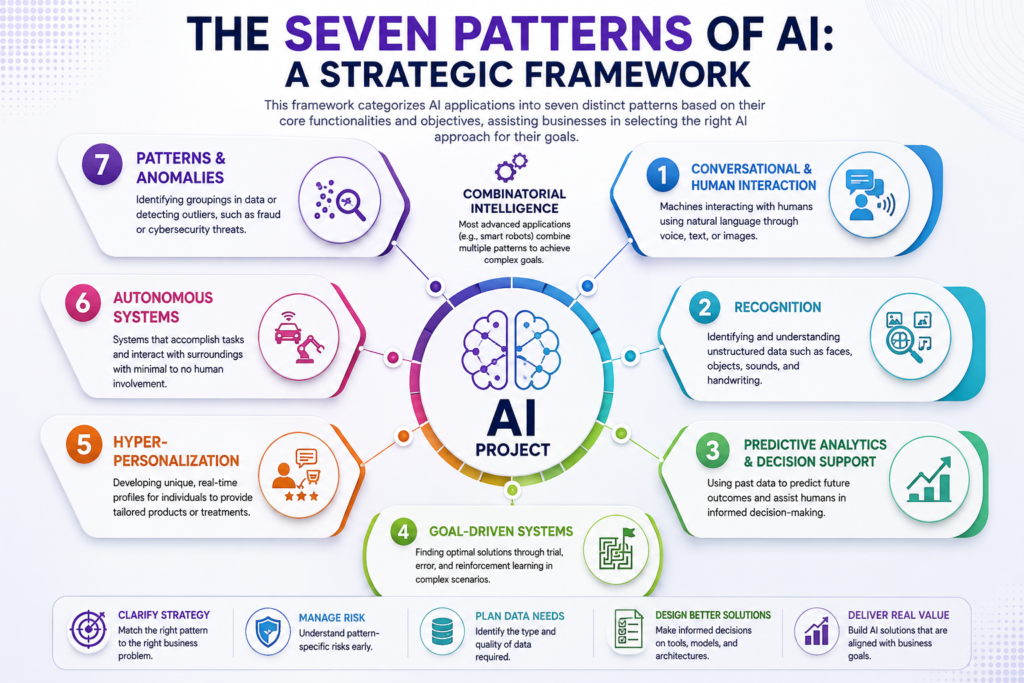
Our team is currently working on an initiative that is exploring use of AI within the Healthcare ‘Referral Management’ workflow. This is a very complex workflow with significant human touchpoints as well as integrations with EHRs and other systems within a hospital. Following the CPMAI guidance, we identified that the AI use can be broken down to two distinct patterns – ‘Recognition’ (for identifying, classifying and processing information within the referral documents received) and ‘Conversational and Human Interaction’ (for interfacing with the hospital staff when processing the referral to set up appointments and follow-ups). Identifying these ‘multipattern’ needs early prevented us from underestimating the project’s complexity and making sure that we were approaching it with a clear understanding of needs around data, technology and risk management.
Why This Matters for Project Managers
Identifying the pattern(s) early changes how you manage the project. If you are working on a Recognition project with labeled data, you know your success depends almost entirely on the quality and availability of this data. If you are building an Autonomous System, your timeline will be longer because the safety and regulatory risks are much higher.
Most advanced applications today are “Composite AI,” meaning they combine several of these patterns into one solution. By breaking them down into these specific patterns, we can “think big but start small,” prioritizing lower-risk patterns first to deliver value quickly before moving toward more complex goals.
Next in the Series
Next in the Series: We move to Phase I: Business Understanding, where we move beyond the hype to achieve actionable business alignment and reach a definitive Go/No-Go decision for the initiative.