The chief operating officer of a regional healthcare network asks what should be a simple question in her Monday morning meeting: how did we perform last week? The answer requires her director of RCM to pull a report from the billing system, her clinical operations lead to pull volume numbers from the EHR, her scheduling manager to check the practice management system, and her credentialing coordinator to email the answer to a fourth question from a fifth system. Each of these people is competent. Each of these systems works. But the picture the COO needs never arrives on Monday morning. It arrives on Thursday, in the form of a slide deck stitched together from four spreadsheets that already disagree with each other by the time they land in front of her. By then, she’s making decisions about next week’s performance without knowing what happened last week.
This is the everyday operational reality inside almost every mid-sized healthcare organization. The systems that run your operation were purchased at different times, from different vendors, for different purposes. Each one is a system of record for something specific. None of them was designed to be the system of record for the operation as a whole. When you need to see across the operation, you don’t; you see across a set of reports, produced by a set of people, on the schedule those people can maintain. The lag between what is happening and what leaders can see is measured in days, sometimes weeks. Decisions get made on old information because current information is not available.
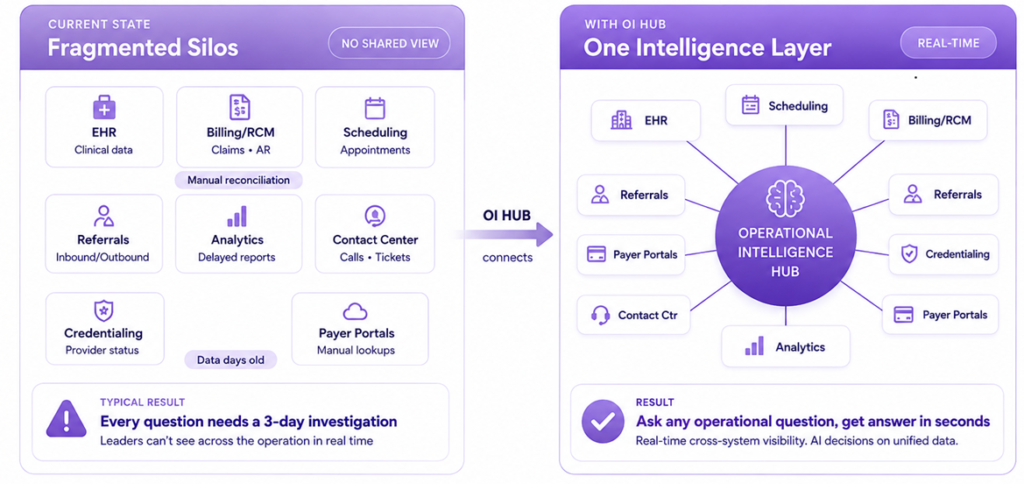
An Operational Intelligence Hub is the architectural response to this problem. It is not another system of record. It is not a replacement for any of your existing systems. It is a shared intelligence surface that sits above them, pulling data continuously from each source, resolving it against a common model, and making the entire operation queryable in real time. This article explains what an OI Hub actually is, what capabilities it delivers that your current systems cannot, what it looks like operationally, and how healthcare organizations get from fragmented silos to unified visibility.
What Fragmentation Actually Costs
Before describing what an OI Hub does, it helps to be honest about what fragmentation costs, because those costs are usually hidden inside the way work happens. When your EHR does not know what your billing system knows, and your billing system does not know what your scheduling system knows, three specific tax lines get imposed on your operation every day. First, every cross-system question requires a person. Someone has to log into System A, pull an extract, log into System B, pull another extract, join them together in a spreadsheet, and answer the question. Simple questions absorb hours of skilled labor across the organization. Complex questions require multi-day investigations by analysts who could be doing higher-value work. The organization pays for this labor whether or not the underlying data was ever going to change the decision.
Second, every cross-system workflow requires manual reconciliation. A patient is scheduled in one system, referred in a second, insured in a third, seen in a fourth, billed from a fifth. Making sure all five systems agree about who this patient is, what they had done, when it was done, and what the payer said requires human beings to catch discrepancies and fix them. When they miss discrepancies — and they always miss some — those errors become denials, rework, patient complaints, or lost revenue. Most of what your RCM team spends its day on is reconciliation between systems that should have agreed automatically.
Third, decisions get made without pattern recognition. When your data lives in silos, no one is looking at the operation as a whole. You cannot easily see that referrals from Practice A convert to appointments 40% less often than referrals from Practice B, because that comparison would require joining data from three systems that never talk. You cannot easily see that Payer C’s denial rate on cardiology claims doubled over the past 60 days, because that pattern is buried in a reason-code field in the billing system, unconnected to your clinical operation. The patterns are there. Nobody sees them because no one has the data assembled to see them.
What an Operational Intelligence Hub Actually Is
An Operational Intelligence Hub is a purpose-built layer that combines four capabilities into a single working system. Each of these capabilities exists in various forms in the market, but the value comes from having them integrated rather than deployed as separate point solutions. The first capability is a common identity layer. Every patient, provider, encounter, claim, and location has a single canonical identifier in the Hub, mapped back to whatever local identifiers each source system uses. When your EHR calls the same person John Doe with medical record number 8834, your billing system calls them John Doe with account 447-A, and your scheduling system calls them John Doe with member ID BC-284729, the Hub knows those are the same person and every downstream query gets the whole story.
The second capability is a unified data model. Data flowing from every source system gets normalized into a consistent shape. Diagnosis codes get standardized to ICD-10 regardless of what internal shorthand each source uses. Encounter types get mapped to a common taxonomy. Financial fields get reconciled across billing and claims systems. Time stamps get harmonized to a single time zone with a single interpretation. What this produces is a data foundation where a query for ‘all diabetic patients with an appointment last week and an unresolved denial’ works, because the definitions of diabetic, appointment, and unresolved denial are stable across the entire dataset.
The third capability is cross-system workflow orchestration. When something happens in one system, the Hub decides what should happen in others. A denial arrives in the billing system, and the Hub automatically opens a related work item, pulls the relevant clinical documentation from the EHR, checks whether the referring provider is still active in the credentialing system, and routes the whole package to the right appeals queue. Workflows that used to require humans copying data between systems now run without human intervention until they need judgment. This is not just efficiency; it is a reduction in the reconciliation errors that fragmentation has been generating for years.
The fourth capability is real-time queryability. Because data is being continuously pulled, normalized, and stored in the Hub, leaders can ask questions and get answers in seconds rather than days. This is where conversational reporting, dashboards, and AI decision support all become genuinely useful — they are all working against the same current, consistent, complete picture of the operation. The Hub is what makes those interfaces possible; without the underlying integration and normalization, dashboards and chatbots are just prettier ways to look at incomplete data.
What Changes on Monday Morning
The most concrete way to describe what an OI Hub does is to walk through what changes for the leaders using it. Consider the COO from earlier, asking how the network performed last week. In the Hub-enabled world, she does not wait for reports. She opens the operating view on Monday morning and sees, in real time, weekly volume by location, revenue realized and revenue at risk, top denial drivers, staff productivity, appointment fill rates, referrals in and out, and outstanding operational issues, all synchronized to the same time window and drawn from every relevant system automatically.
When something looks off, she does not open a ticket. She asks a follow-up question directly against the Hub — why are denials up at the Riverside clinic — and gets an answer in seconds, because the Hub has already joined the clinical, financial, and operational data needed to explain it. She can drill from a metric to the individual records driving it without asking anyone. Her Monday morning meeting becomes a working session about what to do, rather than a status report about what has happened. Her leadership team spends its energy on decisions rather than on data collection. That shift, from producing information to using it, is what an Operational Intelligence Hub is fundamentally about.
What It Is Not
An Operational Intelligence Hub is not a replacement for your EHR, your billing system, your scheduling platform, or your credentialing tool. Those systems keep doing what they do. The Hub is not a data warehouse in the traditional sense, either. Data warehouses were designed for periodic batch loads feeding retrospective analytics; a Hub is designed for continuous flow feeding operational use. It is also not just a BI dashboard layer bolted onto your existing systems. Dashboards are one thing the Hub can drive, but the real value is in the integration and normalization work that makes any dashboard, any AI model, or any workflow above it actually reliable. Vendors who describe their dashboard product as an operational intelligence hub are describing a small piece of the picture and leaving out the hard parts. The hard parts are the integration engineering, the identity resolution, the data model design, and the operational governance — the things that make the Hub something you can actually run your operation on rather than just look at.
How Organizations Get There Without a Multi-Year Project
The instinct when people hear ‘unified data foundation across every system’ is to imagine a three-year, seven-figure initiative that starts with a data governance council and ends with a big-bang launch. That instinct is wrong. Successful OI Hub deployments start with one operational question the business cannot answer today, and they solve for that question end-to-end within 60-90 days. Maybe the first question is: which denials are appealable and worth appealing? Solving that requires pulling data from the billing system, the EHR, and the payer portal, reconciling it against a common patient identifier, and routing it to an appeals workflow. Once that pipeline is built, the same infrastructure supports the next question, then the next. By the end of year one, the Hub is answering a dozen operational questions across RCM, clinical operations, scheduling, and credentialing, each one adding value the moment it goes live rather than waiting for a big-bang unveiling. The point is that the Hub grows outward from real operational use cases, not from an abstract data architecture exercise. Every capability you add pays for itself because it was tied to a decision someone was going to make anyway. Twelve months in, you have a working intelligence layer that covers most of your operational surface. Twenty-four months in, the conversation shifts from ‘we need better visibility’ to ‘we can see across the operation in real time’ — and once that shift happens, the culture of decision-making changes with it. Leaders stop tolerating multi-day answers. Frontline teams start expecting current information. Your competitive position shifts because you can act on what is happening now while peers are still explaining what happened last week.
About BTCNXT
BTCNXT builds hub-and-spoke AI operating models for MSOs and multi-location healthcare networks. From unified data foundations to federated governance to staged rollout templates, we help operations leaders deploy AI that scales with the network rather than fragmenting with it.