Your executive team is enthusiastic about AI. The board is asking when you’ll deploy it. Vendors are calling weekly with demos. And you have a decision to make: greenlight an AI initiative now, or pause and assess whether your organization is actually prepared to succeed with one. The difference between those two paths usually determines whether your AI investment generates returns or becomes another expensive lesson. The healthcare AI graveyard is full of well-funded initiatives that collapsed not because the technology failed, but because the organization wasn’t ready to deploy it. Data wasn’t accessible. Workflows weren’t documented. Staff weren’t trained. Governance didn’t exist. The pilot worked. The scale-up didn’t.
What separates successful AI deployments from failures is a structured readiness assessment performed before significant capital is committed. This isn’t a gut-feel exercise or a vendor scorecard designed to make you look ready. It’s an honest, objective evaluation across the five dimensions that determine whether AI will work at your organization. Most health systems that conduct this assessment honestly discover they have meaningful gaps in two or three dimensions. That’s not a reason to abandon AI. It’s a reason to address those gaps before deploying, not after.
This article walks through the five dimensions of AI readiness, the diagnostic questions that determine your score in each, and how to interpret the result. By the end, you’ll know whether to greenlight, pause and prepare, or invest in foundational improvements first.
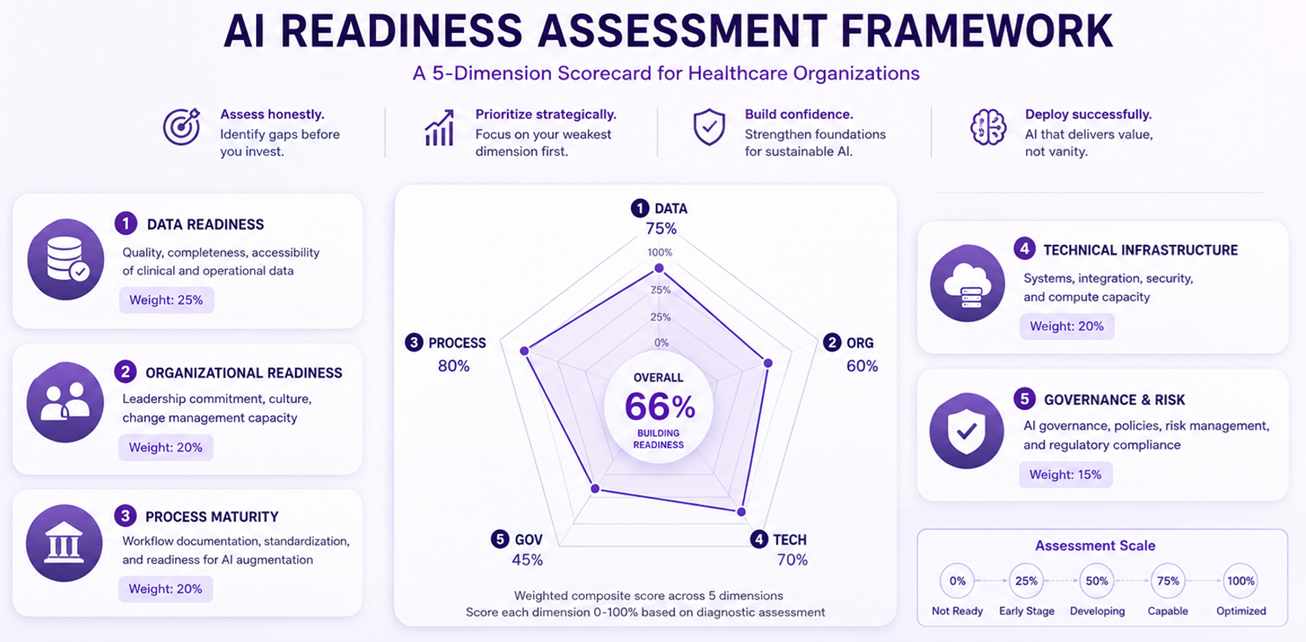
Dimension 1: Data Readiness
Data is the substrate of every AI system. If your data is fragmented, incomplete, inconsistent, or inaccessible, no AI model—however sophisticated—will produce reliable results. Yet most healthcare organizations massively overestimate their data readiness. They assume that because data exists somewhere in their systems, it’s usable for AI. It usually isn’t. The diagnostic questions for this dimension cut through that assumption. Where does your most important clinical and operational data live? If the answer is ‘across seven systems with custom integrations between most of them,’ your data readiness is low even if each individual system is well-managed. How long does it take to produce a clean dataset spanning your enterprise for a specific question? If the answer is measured in weeks, you have a data accessibility problem. What percentage of your clinical data is structured vs. narrative? Most health systems have 70-80% in narrative form. That’s an extraction problem before it’s a modeling problem.
Score this dimension by examining: data accessibility (can analytics teams query without engineering involvement?), data quality (what’s your accuracy rate on critical fields?), data completeness (are there systematic gaps?), and data integration (can you join clinical and financial data without manual reconciliation?). A score below 60% here means you’re not ready to deploy production AI. You may be ready to pilot, but scale will fail.
Dimension 2: Organizational Readiness
Organizational readiness measures whether your people, leadership, and culture can absorb AI-driven change. This is where most assessments are dishonest. Leaders want to believe their organization is ready because they’re personally enthusiastic. The reality is more nuanced. Has your CEO publicly committed to AI as a strategic priority, with budget and political cover attached? Or is it a CIO initiative the rest of the C-suite tolerates but doesn’t champion? AI requires real executive sponsorship because it forces cross-functional decisions—clinical, operational, financial, technical—that can’t be resolved at lower levels.
Beyond executive commitment, examine your change management capacity. How did your last major system change go? If your last EHR upgrade or workflow change took twice as long as planned and left staff resentful, you have a change management problem that AI deployment will surface immediately. Do you have dedicated change management resources, or are you expecting operational managers to handle change in addition to their day jobs? Is there a culture of measurement and continuous improvement, or do people resist when metrics shine a light on their work? AI will require both. Score this honestly. Many organizations score themselves 80% here and are actually at 45%.
Dimension 3: Process Maturity
AI augments workflows. If your workflows are undocumented, inconsistent across locations or teams, or full of informal workarounds, AI will amplify the chaos rather than reduce it. Process maturity is about whether your operational workflows are documented, standardized, and ready to be augmented by AI. Pick three high-priority workflows where you’d want AI assistance: maybe denial prevention, prior authorization, or scheduling. For each, can you produce a current-state process map? Is the process actually followed as documented, or do staff have workarounds? Are the inputs, decision points, and outputs clearly defined? If any of these answers are no, AI deployment for that workflow will require process work before AI work.
The good news: process maturity is the dimension you can improve fastest. Process documentation, standardization, and measurement can be addressed in 90-day sprints. Many organizations score around 50-60% on process maturity and can reach 75%+ in six months with focused effort. This is often the most productive place to invest before AI deployment.
Dimension 4: Technical Infrastructure
Technical readiness covers your infrastructure, integration architecture, security posture, and compute capacity. The diagnostic questions are concrete. Do you have a modern API layer that new systems can integrate with, or does every integration require custom point-to-point work? Do you have a data warehouse or lake where enterprise data flows, or is data still trapped in source systems? What’s your cloud posture—are you cloud-native, hybrid, or fully on-premises? Can you deploy compute resources elastically, or does every new initiative require capacity planning months in advance? Do you have a security framework that can handle AI-specific risks (model drift, adversarial inputs, data leakage), or only traditional cybersecurity? Score this honestly with your IT leaders, not based on vendor marketing claims about your current systems. Most organizations are 60-70% here, which is workable for first AI deployments but limiting for scale.
Dimension 5: Governance and Risk
Governance is the dimension most healthcare organizations score lowest on—and the one that creates the most regulatory and reputational risk if ignored. Do you have an AI governance committee with representation from clinical, operational, legal, compliance, and IT? Do you have policies covering model selection, validation, monitoring, drift detection, and retirement? Do you have a risk framework for AI-specific risks like bias, explainability, and unintended consequences? Can you document the lineage of every AI decision your system makes—who decided what, when, on what basis—for regulatory and legal purposes? If you can’t, you have a governance gap that will become a problem the first time an AI decision is questioned.
Most healthcare organizations score 30-50% on governance because the discipline didn’t exist when their initial AI efforts launched. This isn’t an excuse to skip it. Governance gaps don’t fix themselves and become exponentially harder to retrofit after AI systems are deployed. Invest here before, not after.
Interpreting Your Composite Score

Average your scores across the five dimensions to get a composite readiness score. Below 40%: not ready. Don’t deploy AI yet; invest in foundational improvements. 40-60%: building readiness. You can pilot in well-controlled, lower-risk use cases while improving foundations. 60-80%: capable. You can deploy AI in production with reasonable confidence, focusing on use cases that align with your strongest dimensions. Above 80%: optimized. You can pursue ambitious AI initiatives at enterprise scale. The composite score matters less than the lowest individual dimension score. An organization scoring 85% on four dimensions and 35% on governance will fail at scale, not because of the average but because of the floor. Identify your weakest dimension and address it before deploying AI that depends on it. This honest assessment, performed before commitment, is what separates AI investments that generate returns from AI investments that generate cautionary tales.
About BTCNXT
BTCNXT conducts comprehensive AI readiness assessments for healthcare organizations across all five dimensions, identifying specific gaps and building remediation roadmaps before significant capital is committed. We help you greenlight, pause, or prepare with confidence.
We specialize in,