Artificial Intelligence is reshaping how organizations build products, make decisions, and solve business problems. Yet despite significant investments, many AI initiatives never move beyond experimentation. Delivering successful AI solutions requires more than strong engineering—it demands a different way of thinking about project management, data, governance, and business outcomes.
In this blog series, Shyam Deval, Customer Success Champion at BTCNXT, shares his personal journey toward becoming a PMI Certified Professional in Managing AI (PMI-CPMAI™). Drawing from real project experiences, he reflects on the lessons learned while managing AI initiatives, why traditional software delivery approaches often fall short, and how the CPMAI methodology provides a practical framework for turning AI concepts into measurable business value.
This first article explores the experiences that motivated Shyam to pursue the certification and why he believes the future of project management is evolving from coordinating software delivery to orchestrating intelligent systems. Throughout the series, he will break down each phase of the CPMAI framework and share practical insights that project managers, AI practitioners, and business leaders can apply to their own AI transformation journeys.
The AI Delivery Challenge: Why So Many Projects Fail
I’ve spent my career navigating various technology waves, but the current surge toward Artificial Intelligence feels fundamentally different. It’s faster, more complex, and packed with incredible promise. Yet, if you look past the headlines, there is a startling paradox in our industry: nearly 80% of AI projects still stall or fail to reach production.
In 2025 alone, we saw a massive spike in businesses scrapping their AI initiatives entirely, rising to 42%, a huge jump from just 17% the year before. Why is this happening? It isn’t usually because the math is wrong or the engineers aren’t talented. These projects fail because we are trying to manage 21st-century intelligence using 20th-century project models that simply cannot keep up with AI’s unique, data-driven rhythm.
I recently experienced this during a project focused on AI document classification. We planned the execution using adaptive Agile sprints, a methodology my team knows inside and out. On the surface, the first few sprints were a success. But we soon hit a wall: we couldn’t secure access to the real-world document data needed for fine-tuning the model.
To maintain momentum, we pushed forward using synthetic data, but the model crumbled during verification against actual datasets. What followed was a spiral of repetitive work and growing frustration for both our team and the client. It was the ultimate proof that in AI, you can’t just iterate on code; if you haven’t mastered the critical groundwork of understanding and preparing your data first, even the most ‘Agile’ team in the world will still find themselves standing still.
That realization is exactly what led me to the PMI Certified Professional in Managing AI (PMI-CPMAI)™. I didn’t just want another badge; I needed a structured, repeatable roadmap that turns technical experiments into actual business value.
Filling the Gap: Where Traditional PM Falls Short
The Cognitive Project Management in AI (CPMAI) methodology was born in 2017 to fill a massive void. Agile is brilliant for software, but it often ignores the rigorous “data-centric” iteration that AI requires. On the other side, older models like CRISP-DM were built for data mining but lacked the modern focus on ethics, governance, and the continuous monitoring that today’s models demand.
By blending the best of these worlds into a six-phase iterative cycle, CPMAI has become the global gold standard for AI transformation.
Intelligence is Not Just "Better Automation"
One of the most important lessons I’ve learned is how to spot when a project isn’t actually an “AI project.” We often see people trying to use “probabilistic” AI for “deterministic” tasks.
- Traditional Automation follows fixed “if-this-then-that” rules for stable, repetitive tasks like email autoresponders or batch jobs.
- AI is different. It handles variability and complexity through what the standard calls the Three Ps of Intelligence: Perception (sensing the world), Prediction (foreseeing outcomes), and Planning (dynamically optimizing actions).
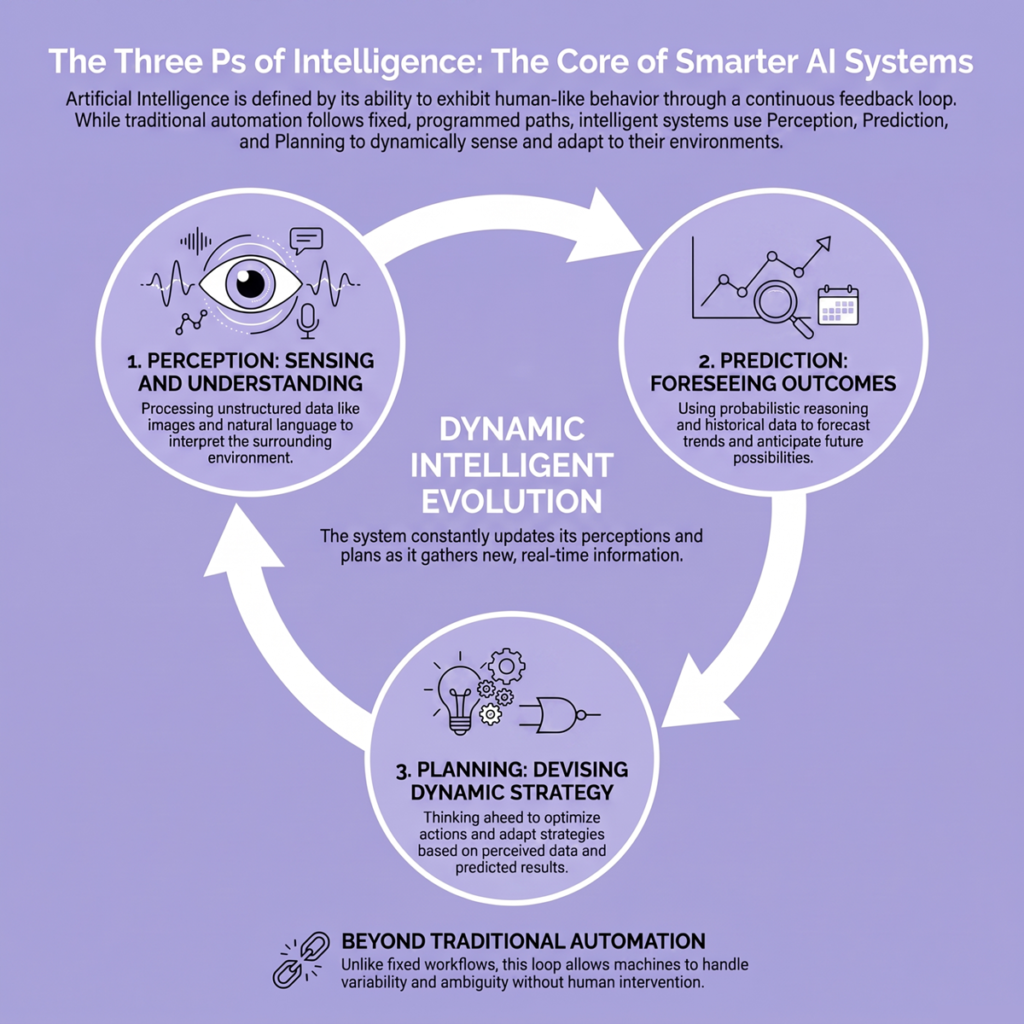
If your system doesn’t need to perceive, predict, or plan, you probably just need a good automation script—not an expensive, resource-heavy AI model.
Why CPMAI Still Wins in a GenAI and Agentic World
You might wonder if a methodology created years ago is still relevant in the age of Generative AI and Agentic AI. The answer is: more than ever. These advanced systems bring massive new risks like hallucinations, hidden bias, and emergent behaviors.
CPMAI also provides the rigorous checkpoints and “human-in-the-loop” (HITL) oversight required to ensure that even the most autonomous agents remain safe, ethical, and aligned with our human goals.
Changing role of Project Manager
For much of my career, the role of a PM was often synonymous with ‘task manager’- the person responsible for chasing documentation, managing schedules, and keeping the gears of routine work turning. But AI is rapidly absorbing those administrative burdens. I believe we are entering the era of the AI Orchestrator.
My journey through the CPMAI certification taught me that a Project Manger’s value no longer lies in the tasks AI can do faster, but in the complexities AI cannot handle alone. It’s about guiding teams through the ‘probabilist’ nature of AI initiatives, navigating a technology landscape that evolves almost weekly, and ensuring that our business goals don’t get lost in the technical noise. CPMAI doesn’t just provide a methodology; it provides the leadership framework to manage this transition with confidence.
Next in the Series
We’ll dive into Phase I: Business Understanding, where we use the Seven Patterns of AI to prove if your business problem is a true candidate for AI.